
Why We Need to Mitigate Carbon Emissions Right Now
The single most important thing you can do to mitigate carbon emissions is shift away from fossil fuels — in how you power your home, how you travel, and what you eat. Here’s a quick-reference breakdown of the highest-impact actions:
Top ways to mitigate carbon emissions:
- Go car-free or switch to an EV — saves up to 2 tons of CO2e per year
- Switch home energy to renewables — saves up to 1.5 tons of CO2e per year
- Improve home insulation or install a heat pump — saves up to 900 kg of CO2e per year
- Shift to a plant-based diet — saves up to 900 kg of CO2e per year
- Take one fewer long-haul flight — saves up to 2 tons of CO2e per trip
Our climate is changing — and it’s changing fast.
Human activities have pushed atmospheric carbon dioxide 50% above pre-industrial levels. In 2013, daily CO2 crossed 400 parts per million for the first time in human history. Scientists warn that global emissions must peak before 2025 and fall by 43% by 2030 just to keep warming below 1.5°C.
Without action, current policies put us on track for 2.7°C of warming by 2100. That’s not a distant problem. It’s a trajectory being locked in by decisions made today.
The good news? It’s not too late. The tools, technologies, and strategies to turn this around already exist — from grid-scale renewables to small daily habits. And many of them save money while cutting emissions.
This guide breaks it all down: from the biggest global sources of greenhouse gases, to what you can do this week in your own home.
Understanding the Urgency of Climate Change Mitigation
When we talk about climate change mitigation, we are talking about human intervention to reduce the sources of greenhouse gases (GHGs) or enhance the “sinks” that store them. It is a race against chemistry. For the past 10,000 years, Earth’s climate remained relatively stable, allowing our civilizations and agriculture to flourish. However, since the industrial revolution, we have fundamentally altered the atmosphere.
The Intergovernmental Panel on Climate Change (IPCC) has made it clear: to avoid the most catastrophic threats of global warming, we must halve global emissions by 2030 and reach net-zero by 2050. Currently, the daily level of carbon dioxide in our atmosphere has surpassed 400 parts per million (ppm)—a level not seen in millions of years.
Achieving the 1.5°C limit isn’t just a scientific preference; it’s a threshold for environmental stability. Beyond this, we risk triggering “tipping points,” such as the irreversible melting of ice sheets or the mass die-off of coral reefs. Scientific research on climate change mitigation shows that while the challenge is massive, demand-side solutions alone—like changing our diets and how we travel—could reduce global emissions by 40% to 70% by 2050.
Primary Sources of Global Greenhouse Gas Emissions
To effectively mitigate carbon emissions, we first have to know where they are coming from. It isn’t just one “bad” industry; it is a systemic reliance on carbon-intensive processes across every sector of modern life.
In 2016, the energy sector (including electricity, heat, and transport) was responsible for a staggering 73.2% of global emissions. Industrial processes contribute about 5.2%, while waste management accounts for roughly 3.2%. Agriculture, forestry, and other land uses make up about 18.4% of the global total.
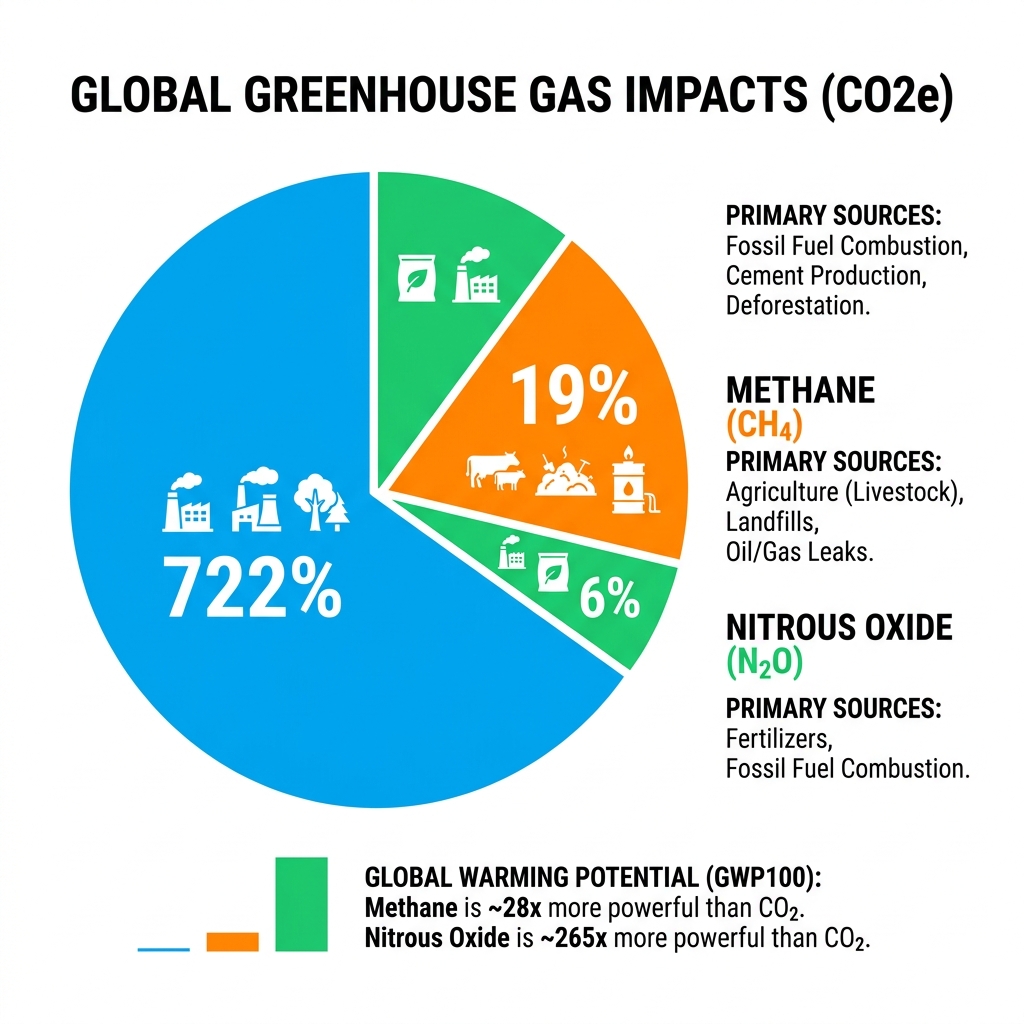
| Gas Type | Global Share (2020) | Primary Sources |
|---|---|---|
| Carbon Dioxide (CO2) | 72% | Fossil fuel combustion, cement production, deforestation |
| Methane (CH4) | 19% | Agriculture (livestock), landfills, oil/gas leaks |
| Nitrous Oxide (N2O) | 6% | Fertilizers, fossil fuel combustion |
| Fluorinated Gases | 3% | Refrigeration, industrial processes |
The Role of Fossil Fuels in Global Warming
Fossil fuels are the heavy hitters of the climate crisis. Coal-fired power stations remain the single largest source of emissions, accounting for 20% of the global total. When we burn coal, oil, or natural gas for energy, we release carbon that has been stored underground for millions of years back into the atmosphere in an instant. Even cement production is a major player, contributing about 4% of global CO2 emissions due to the chemical reactions required to create the material.
Land Use and Agricultural Contributions
We often forget that the ground beneath our feet is a massive carbon player. Human-caused land-use changes, such as converting forests to farms, cause about one-quarter of climate change. Agriculture alone contributes nearly 11% of total emissions in the United States.
Livestock and manure produce 5.8% of all global emissions, primarily in the form of methane—a gas that is much more potent at trapping heat than CO2 in the short term. Furthermore, the degradation of peatlands and mangroves is particularly damaging. Peatlands cover only 3% of the Earth’s land but store 42% of all soil carbon. When they are drained or burned for agriculture, they become massive “carbon bombs.”
Global Strategies to Mitigate Carbon Emissions
Governments and international bodies are finally shifting gears. The Paris Agreement serves as the primary roadmap, pushing nations to set “Nationally Determined Contributions” (NDCs) to limit warming.
The European Union has emerged as a leader here. By 2023, the EU achieved a 37% reduction in emissions compared to 1990 levels. Their target is even bolder: a net 55% reduction by 2030 and full climate neutrality by 2050. This progress was driven largely by a massive shift to renewable energy and a decline in coal use.
Climate change mitigation: reducing emissions requires a “carrot and stick” approach. We see this in the Global Methane Pledge, which aims to cut methane emissions by 30% by 2030. Methane stays in the atmosphere for a shorter time than CO2, so cutting it now provides a “quick win” for slowing down immediate warming.
Protecting and Enhancing Natural Carbon Sinks
While we work on cutting emissions at the source, we must also protect the Earth’s natural ability to breathe. Forests, oceans, and soils are our best allies. Photosynthesis is, quite literally, the most efficient carbon-capture technology ever “invented.”
However, these sinks are under pressure. Between 2014 and 2023, the EU’s forests and land absorbed 30% less carbon than in the previous decade due to climate-related stresses like drought and pests. To mitigate carbon emissions effectively, we must halt deforestation and engage in massive wetland and forest restoration.
Policy Frameworks and Economic Incentives
How do we make the transition affordable? Policies like carbon pricing—either through a carbon tax or “cap and trade” systems—make it more expensive to pollute. In the U.S., programs like the Colorado C-PACE have helped commercial buildings save over $68 million through energy upgrades. Tax credits for Zero Emission Vehicles (ZEVs) and renewable energy certificates (RECs) are also making green technology the more financially attractive choice for businesses.
Sector-Specific Solutions for a Low-Carbon Future
Transitioning to a low-carbon economy isn’t just about “using less”; it’s about using better. This involves the “electrification of everything.” If we can clean up the power grid with wind and solar, and then run our cars and home heaters on that clean electricity, we slash a huge portion of our footprint.
How to Mitigate Carbon Emissions at Home
Your home is your personal climate headquarters. You don’t need to live in a cave to be eco-friendly; you just need to be efficient.
- Energy Audits: Before you spend money, find out where you’re losing it. An audit identifies leaks in insulation and inefficient appliances.
- Weatherization: Simple fixes like sealing windows and home-insulation-enhancing-energy-efficiency can drastically reduce the energy needed for heating and cooling.
- The Heat Pump Shift: Moving from a gas furnace to an electric heat pump can reduce your footprint by up to 900 kg of CO2e per year.
- Smart Habits: Washing clothes in cold water and using LED bulbs are “low-hanging fruit” that add up. For more tips, check out our guide on reducing-carbon-footprint-at-home.
Sustainable Dietary and Lifestyle Changes
What we put on our plates matters just as much as what we put in our gas tanks. Shifting from a mixed diet to a vegetarian one can save 500 kg of CO2e annually, while a vegan diet can save up to 900 kg. This is because raising animals requires significantly more land, water, and energy than growing plants.
Beyond food, we need to look at our “stuff.” Every kilogram of textiles produced generates about 17 kg of CO2e. By avoiding “fast fashion,” buying quality goods that last, and embracing the circular economy (reduce, reuse, repair, recycle), we can curb the 1.8 billion metric tonnes of emissions generated by plastics and consumer waste each year. The Actions for a healthy planet | United Nations initiative reminds us that the wealthiest 10% of the global population account for nearly half of all emissions—meaning those of us in developed nations have the biggest opportunity to drive change through our choices.
Emerging Technologies to Mitigate Carbon Emissions
While we have the tools to start today, new technologies are expanding the toolkit. We are moving beyond just “reducing” to actively “removing” carbon from the sky.
Innovations in Transportation and Industry
The transportation sector has seen a revolution. Switching from a gasoline car to an EV can reduce your footprint by 2 tons of CO2e annually. But industry is also evolving. We are seeing the rise of “green hydrogen” for heavy shipping and low-carbon cement for construction. In Colorado, the City of Grand Junction’s wastewater plant even captures methane to produce vehicle fuel, powering 70 fleet vehicles and reducing emissions by 3 million pounds per year.
The Future of Carbon Sequestration
Carbon Capture and Storage (CCS) involves catching emissions at the factory pipe and pumping them deep underground into geological formations. Even more futuristic is Direct Air Capture (DAC), which acts like a giant mechanical tree to suck CO2 directly out of the ambient air.
We are also looking at “Blue Carbon”—the carbon stored in coastal ecosystems like mangroves, which can store carbon 40 times faster than tropical forests. To track all of this, we use satellite data like the Copernicus service, which provides precise vegetation data to ensure our natural sinks are actually doing their jobs.
Frequently Asked Questions about Carbon Mitigation
What is the difference between mitigation and adaptation?
Mitigation is about prevention—reducing the greenhouse gases we put out so the climate doesn’t change as much. Adaptation is about preparation—building sea walls, developing drought-resistant crops, and preparing for the changes that are already happening because of past emissions. We need both.
Can individual actions really make a difference in global emissions?
Absolutely. While policy and corporate change are vital, demand-side solutions (our choices) can reduce global emissions by up to 70% by 2050. When we change our habits, we also shift the market, making green options cheaper and more accessible for everyone else.
What are the most cost-effective ways to reduce a carbon footprint?
Energy efficiency is almost always the “cheapest” way to mitigate carbon emissions because it pays for itself. Better insulation, LED bulbs, and smart thermostats reduce your monthly utility bills while cutting your footprint. Similarly, eating less meat and driving less (carpooling or walking) saves money immediately.
Conclusion
The path to a sustainable future is not a sacrifice; it is an upgrade. When we mitigate carbon emissions, we aren’t just “saving the planet”—we are creating a world with cleaner air, quieter streets, healthier diets, and more resilient economies.
From the EU’s massive policy shifts to a single homeowner installing a heat pump, every action counts toward that 2030 goal. We have the technology, the economic incentives, and the scientific roadmap. All that remains is the collective will to act.
At Refugio do Jardim, we believe that a green lifestyle is a better lifestyle. Whether you are starting with a home energy audit or shifting to a plant-based diet, you are part of the global transition to net-zero. Let’s get to work.
For more practical tips on living a low-carbon life, explore our More info about sustainable living resources and join us in protecting the garden we all share.
