
Why a Wind Turbine Home Setup Could Change How You Power Your Life
A wind turbine home setup is one of the most effective ways to generate your own clean electricity and reduce your reliance on the grid.
Here’s a quick overview of what it takes to get started:
- Assess your wind resource – You need an average annual wind speed of at least 10 mph at your site
- Check local rules – Zoning laws, permits, HOA approvals, and utility notification are required before installation
- Choose the right turbine – Match turbine size to your energy needs (a typical U.S. home uses about 10,649 kWh per year)
- Prepare the foundation – Concrete foundations with anchor bolts support the tower safely
- Handle electrical integration – Connect to an inverter, your home panel, and optionally the utility grid via net metering
- Plan for maintenance – Routine blade cleaning, lubrication, and annual inspections keep the system running
More and more homeowners are asking a simple question: Can the wind on my property actually power my home?
The answer is often yes — if conditions are right.
About 19.3% of the U.S. population lives in rural areas with enough land to make a residential wind system viable. And for those in the right locations, a properly sized turbine can meaningfully cut electricity bills, boost energy independence, and even allow excess power to be sold back to the grid.
But wind energy is not plug-and-play. It requires real planning, the right site, and a clear understanding of the process — from permits to foundation work to electrical connections.
This guide walks you through every step, so you can decide if a home wind setup makes sense for you — and how to do it right if it does.
Understanding the Basics of a Wind Turbine Home Setup
Before we start digging holes and pouring concrete, we need to understand exactly what we are building. A wind turbine home setup is essentially a miniature power plant. While commercial wind farms use massive turbines that tower hundreds of feet in the air, residential systems are scaled down to fit on private property.
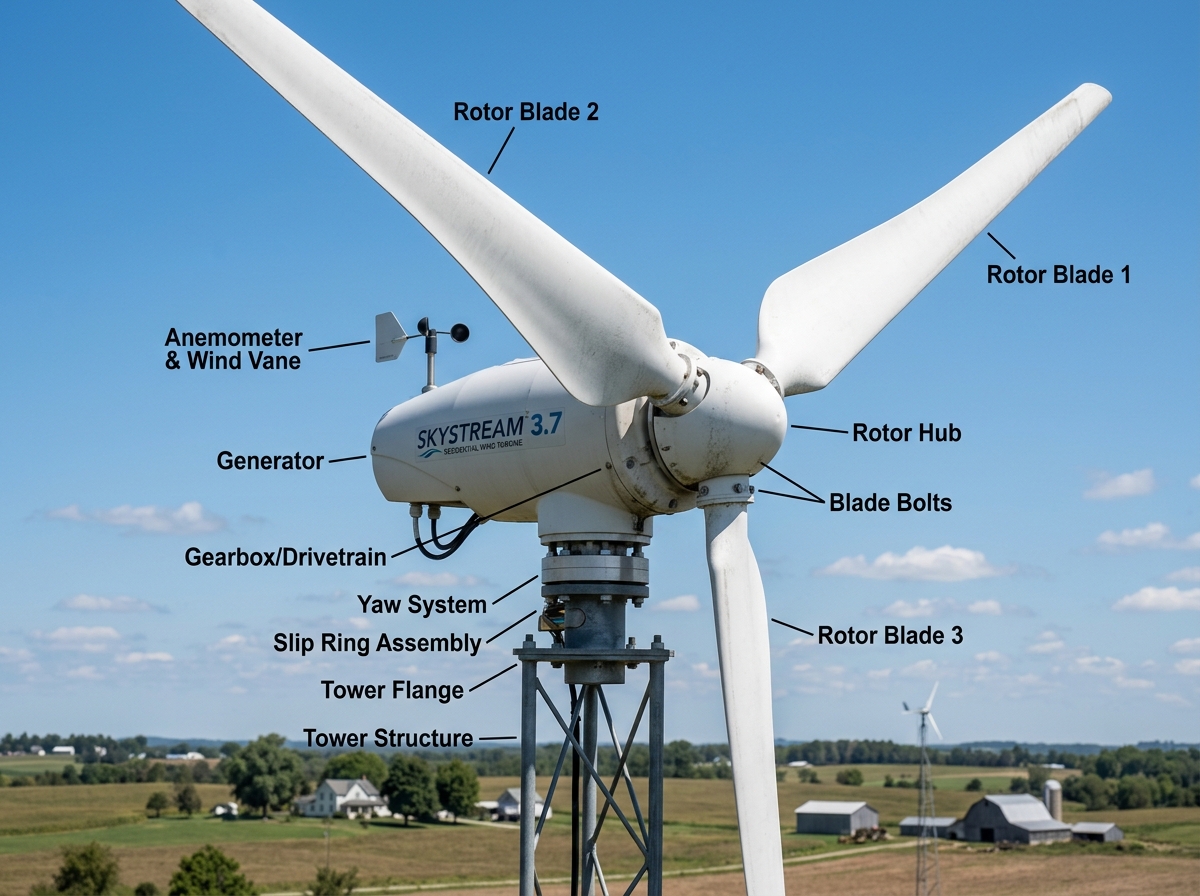
The system consists of several critical parts: the rotor blades, the nacelle (which houses the generator), and the tower. According to the Small Wind Guidebook | Department of Energy, these systems can range from tiny 20-watt units for charging batteries to 100-kW machines capable of powering a large farm.
Basic Components and How They Work
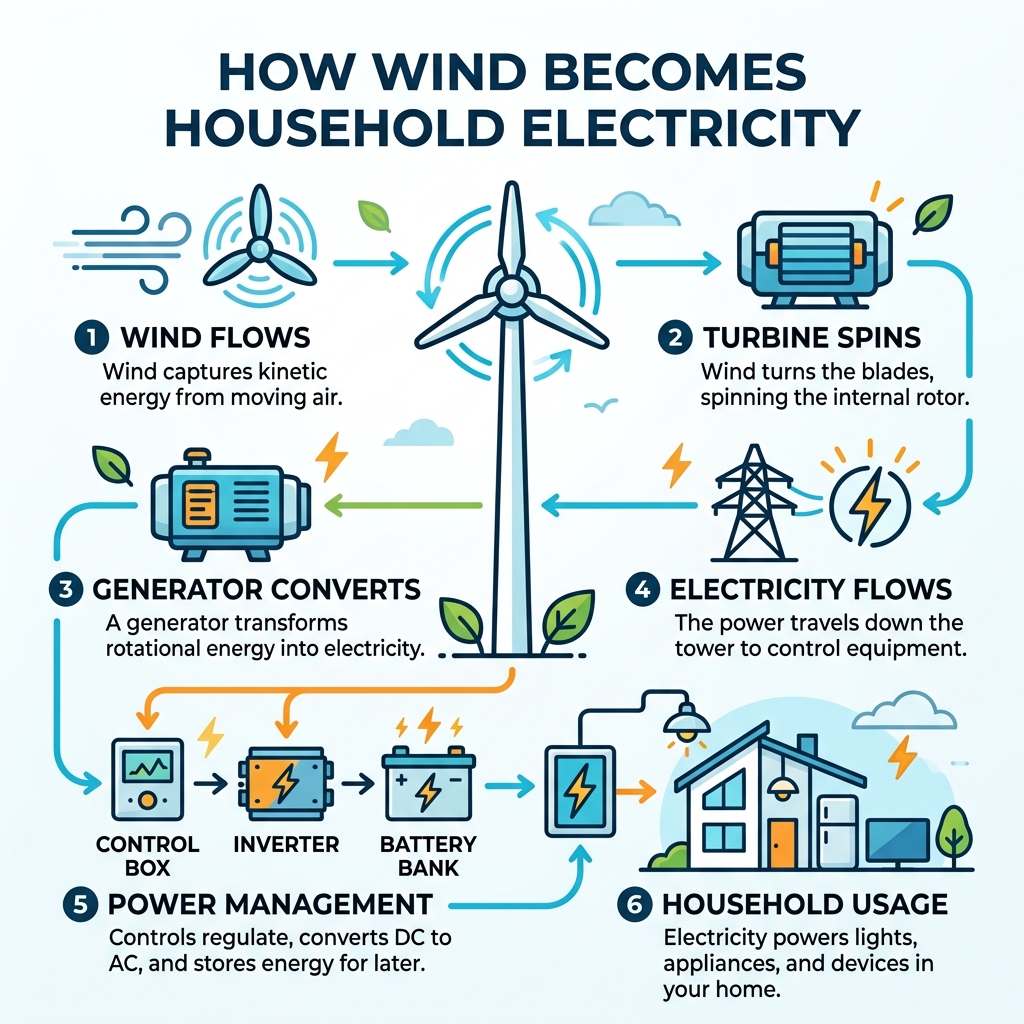
At its heart, a wind turbine is the exact opposite of a desk fan. Instead of using electricity to make wind, it uses wind to make electricity.
- Kinetic Energy: The wind blows past the turbine’s blades, capturing kinetic energy.
- Mechanical Power: This force causes the blades to rotate, turning a central shaft.
- Shaft Rotation: The spinning shaft enters the nacelle, where it connects to a generator.
- Electricity Generation: Inside the generator, magnets spin past wire coils to create an electrical current.
This energy starts as Direct Current (DC) or variable Alternating Current (AC) and must be processed by an inverter before it can safely run your toaster or your TV.
Choosing Between Horizontal and Vertical Designs
When researching your wind turbine home setup, you will encounter two main “looks”:
- Horizontal-Axis Wind Turbines (HAWT): These look like traditional windmills or airplane propellers. They are the most common and generally offer the highest aerodynamic efficiency. They use a tail vane to “track” the wind, ensuring they always face the breeze.
- Vertical-Axis Wind Turbines (VAWT): These look a bit like a giant eggbeater or a spinning whisk. They don’t need to point into the wind to work, which makes them great for areas with multidirectional or turbulent winds. While they are often quieter and easier to maintain (since the generator is near the ground), they typically produce 30-40% less energy than a HAWT of the same size.
Assessing Property Wind Potential
You wouldn’t install solar panels in a dark cave, and you shouldn’t install a wind turbine in a dead-calm valley. The success of your project depends entirely on your “wind resource.”
To make a wind turbine home setup worthwhile, you generally need a site with average annual wind speeds of at least 10 mph. If you can hit 12-15 mph, you’re in the “sweet spot” where the system starts paying for itself much faster. You can find more on optimizing your property’s energy in our guide on harnessing-energy-efficiency-essential-tips-for-eco-friendly-homes/.
Tools for Measuring Local Wind
Don’t just guess based on how often your wind chimes jingle. Accurate data is key.
- Anemometers: These small devices measure wind speed. We recommend installing one at your proposed turbine height for at least a few months (ideally a year) to get a true reading.
- Wind Vanes: These show you the prevailing wind direction, helping you spot where the “cleanest” air comes from.
- Wind Maps: Tools like NOAA data or Department of Energy wind maps provide a good starting point, but local hills, trees, and buildings can drastically change the wind on your specific acre.
Ideal Site Conditions and Obstructions
The biggest enemy of a home wind turbine is turbulence. When wind hits a house or a tree, it tumbles like water over a rock, becoming “dirty” and unusable for power.
To avoid this, follow the 30/300 rule: The bottom of your turbine blades should be at least 30 feet above any obstacle (trees, houses, silos) within a 300-foot radius. If your neighbor has a 50-foot oak tree 200 feet away, your tower needs to be at least 80 feet tall. Elevation is your friend; wind speeds can be 15-25% higher just by moving from a short tower to a taller one.
Planning, Permits, and Legal Requirements
Before you buy a single bolt, you need to talk to the “powers that be.” Installing a 60-foot tower in your backyard tends to get the neighbors talking, and the local government usually has some opinions on it too.
For a deeper dive into residential requirements, check out Residential Wind Power: About At-Home Turbines | Perch Energy.
Navigating Zoning and Utility Interconnection
- Zoning Laws: Many residential areas have a height limit of 35 feet. To go higher (which you almost always need to do for wind), you may need a “variance” or a special permit.
- HOA Approvals: If you live in a community with a Homeowners Association, check your covenants. They may have rules about aesthetics or noise.
- Utility Notification: If you plan to connect to the grid, you must notify your utility company. They will require your system to meet IEEE 1547 compliance—a fancy way of saying your turbine won’t accidentally electrocute a line worker during a power outage.
- Net Metering: This is the “holy grail” of home wind. It allows you to send excess power back to the grid, effectively spinning your meter backward and earning you credits on your bill.
Selecting the Right Turbine Size
How much power do you actually need? A typical U.S. home uses approximately 10,649 kilowatt-hours (kWh) per year, or about 877 kWh per month.
A 1.5-kW wind turbine can meet the needs of a home requiring 300 kWh per month—provided you have a steady 14 mph average wind speed. To fully offset a standard home’s usage, you are likely looking at a turbine in the 5-kW to 15-kW range. Always look at the “capacity factor”—real-world wind isn’t constant, so a turbine rarely produces its “rated” power 24/7.
The Installation Process and Electrical Integration
Now for the heavy lifting. A wind turbine home setup requires a mix of masonry, carpentry, and electrical work. If you’re not comfortable with high-voltage wiring or pouring tons of concrete, this is the time to call in a professional. We have covered other ways to improve your property in our making-your-home-green-a-comprehensive-guide/.
Step-by-Step Guide to Your Wind Turbine Home Setup
- Foundation Preparation: You can’t just stick a pole in the dirt. For a standard 60-foot monopole, you might need a hole 9 feet in diameter and 3 feet deep. You’ll install anchor bolts, a grounding system, and pour several yards of concrete.
- Trenching: Dig a trench from the tower base to your home to run the electrical conduit.
- Tower Assembly: Most towers come in sections. You’ll bolt these together on the ground.
- Mounting Components: Attach the nacelle, the tail vane, and finally the blades. Ensure everything is balanced perfectly—a wobbling turbine is a failing turbine.
- Raising the Tower: This is the most dramatic part. You might use a crane, or a tilt-up tower with an electric winch system.
Handling Electrical Connections and Inverters
The electricity coming off your turbine is “wild”—it changes voltage and frequency as the wind gusts.
- Inverter: This is the brain of the system. It converts the variable power into a steady 120V or 240V AC that your home can use.
- Charge Controller: If you are off-grid, this prevents your battery bank from overcharging.
- Grid-Tie Inverter: If you’re connected to the utility, this synchronizes your power with the grid’s frequency.
DIY vs. Professional Installation Comparison
| Task | DIY Potential | Professional Recommendation |
|---|---|---|
| Site Assessment | High (with tools) | Recommended for precision |
| Foundation Digging | High | If you can operate a backhoe |
| Concrete Pouring | Moderate | Must be structurally perfect |
| Tower Raising | Low | High risk of injury/damage |
| Electrical Wiring | Low | Required for grid-tie/safety |
| Maintenance | High | Great for homeowners |
Maintenance, Safety, and Common Pitfalls
A wind turbine is a machine with moving parts exposed to the harshest elements. To keep it spinning for its expected 20-25 year lifespan, you have to be proactive. You can find more general tips for maintaining a sustainable home in our creating-an-eco-friendly-home-a-comprehensive-guide/.
Safety Precautions and Professional Inspections
- Braking Systems: Ensure your turbine has a fail-safe brake (mechanical, electronic, or “furling”) to stop the blades during extreme storms.
- Fall Protection: If your tower isn’t a “tilt-down” model, never climb it without a professional harness and fall-arrest system.
- Annual Checks: Every year, you should tighten every bolt, check for rust, lubricate the yaw bearings, and inspect the blades for cracks or leading-edge erosion.
Top Mistakes to Avoid During Setup
- Roof Mounting: This is the #1 mistake. Turbines on roofs cause vibrations that can damage your home’s structure, and the wind near a roof is usually too turbulent to produce much power.
- Poor Foundation: A 2-kilowatt turbine can exert enormous “overturning” force during a gust. If your foundation isn’t deep enough, the whole thing can tip over.
- Ignoring the Neighbors: A noisy or flickering turbine can lead to legal headaches. Choose a model with a low decibel rating (around 55 dB is standard) and site it away from property lines.
Costs, Savings, and Hybrid Energy Systems
Let’s talk numbers. A wind turbine home setup is a significant investment. In 2021, the average cost for small wind projects was about $5,120 per kilowatt. That means a 5-kW system could run you $25,000 or more before incentives.
However, the Federal Investment Tax Credit (ITC) can often cover 30% of the cost, significantly shortening your payback period. For more ways to save, check out the-power-of-conservation-essential-energy-saving-tips-for-every-home/.
Integrating Wind with Solar and Batteries
We often recommend a hybrid system. Why? Because the wind often blows when the sun isn’t shining (at night and during winter). By combining a wind turbine with solar panels and a battery bank (like modern sodium-ion or lithium batteries), you get a much more stable energy profile. This is especially vital for off-grid living where you can’t rely on the utility company as a “backup battery.”
Realistic Energy Production and ROI
Don’t expect your turbine to eliminate your bill overnight. Most residential systems have a payback period of 15 to 25 years. However, as utility rates continue to rise, that period may shrink. Beyond the money, you’re gaining energy autonomy and significantly reducing your carbon footprint—the average home turbine cuts about 2,000 kg of CO2 emissions per year.
Frequently Asked Questions about Wind Turbine Home Setups
What is the minimum wind speed required for a home turbine?
Most turbines require a “cut-in” speed of about 6-8 mph to start spinning, but they won’t produce meaningful electricity until the wind hits 10-12 mph. If your area averages less than 9 mph, wind might not be the best investment for you.
Can I install a wind turbine on my roof?
We strongly advise against it. Roof-mounted turbines are subject to “boundary layer” turbulence, meaning the air is slow and messy. Plus, the mechanical vibrations can be incredibly loud and destructive to your home’s framing. Pole-mounted is always the way to go.
How much noise does a residential wind turbine make?
A typical 2-kilowatt turbine operates at approximately 55 dB when measured 50 feet away. For context, that’s quieter than a standard vacuum cleaner and about the same level as a quiet conversation. Modern blade designs have made “whooshing” sounds much less noticeable.
Conclusion
At Refugio do Jardim, we believe that the transition to a sustainable future starts right in your own backyard. A wind turbine home setup isn’t just a piece of machinery; it’s a statement of independence and a commitment to the planet.
While the planning and installation process can be complex, the reward of watching your meter spin backward on a breezy afternoon is unmatched. By carefully assessing your site, following local regulations, and choosing quality components, you can harness the power of the air to fuel your daily life.
Ready to explore more ways to make your home a green sanctuary? Check out More eco-friendly home tips and join us in the renewable revolution. The wind is waiting!
