
Stop Holding Your Breath and Purify Air Naturally
The Air Inside Your Home May Be More Toxic Than You Think
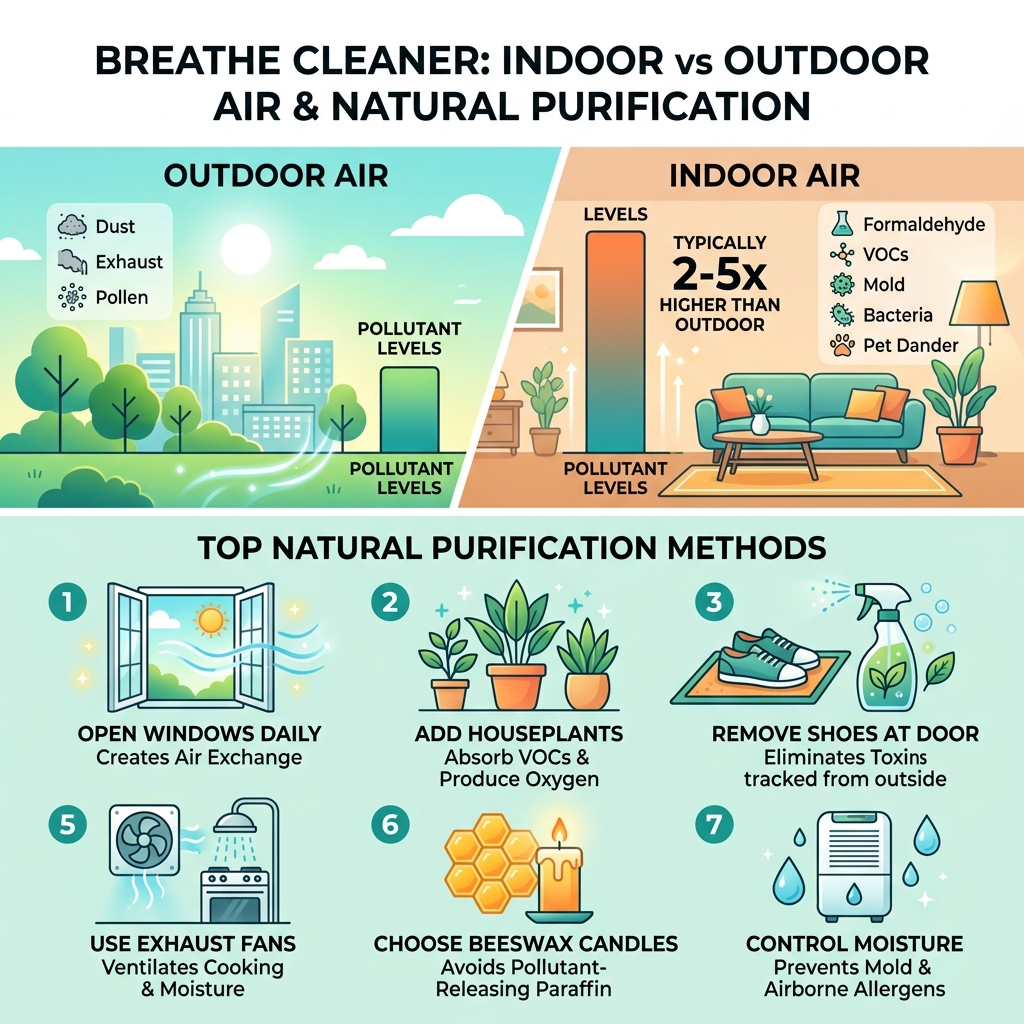
How to purify air naturally at home is simpler than most people expect. Here are the most effective natural methods:
- Open windows daily – even 15 minutes creates meaningful air exchange
- Add houseplants – aim for at least one per 100 square feet
- Remove shoes at the door – reduces carpet toxins by up to 60%
- Switch to non-toxic cleaners – eliminates a major source of VOCs
- Use exhaust fans – especially when cooking or showering
- Choose beeswax candles – over pollutant-releasing paraffin alternatives
- Control moisture – to prevent mold and airborne allergens
You probably spend most of your time indoors. Most people do.
But here’s the uncomfortable truth: the air inside your home can be 2 to 5 times more toxic than the air outside, according to the EPA. In some cases, indoor pollutant levels run 100 times higher than outdoor air. And you can’t see it, smell it, or feel it — until your body starts reacting.
The culprits are everywhere. Pressed wood furniture releases formaldehyde. Cleaning sprays release volatile organic compounds (VOCs). Gas stoves pump out nitrogen dioxide. Even your carpet quietly holds onto bacteria, mold, and pesticides tracked in from outside.
The good news? You don’t need expensive equipment or a lifestyle overhaul to fix it. Small, consistent actions make a real difference — and most of them cost nothing.
How to Purify Air Naturally at Home Through Ventilation
When we think about “cleaning,” we usually think about scrubbing surfaces. But the air is a fluid, and the most effective way to clean a fluid is to replace it. This is where ventilation comes in. If your home is sealed tight to save on energy, you are essentially living inside a plastic bag filled with your own emissions.

According to the Improving Indoor Air Quality | US EPA, increasing the amount of outdoor air coming indoors is a primary strategy for health. Most modern HVAC systems do not actually “breathe”; they just recirculate the same stale air. To truly refresh your space, we need to look at natural physics.
One fascinating concept is the Stack Effect. This happens when hot air rises and escapes through high openings (like attic vents or skylights), creating a vacuum that pulls cooler, fresh air in through lower windows. It’s a passive, zero-cost way to flush out pollutants. Even if you don’t have skylights, simply using your exhaust fans in the bathroom and kitchen helps pull “old” air out, forcing “new” air to find its way in through small gaps and vents.
Master the Art of Natural Air Purification with Cross-Ventilation
To truly master how to purify air naturally at home, you need to understand cross-ventilation. Opening a single window is okay, but opening two windows on opposite sides of a room creates a “wind tunnel” effect that physically pushes pollutants out.
We recommend the 15-minute rule: open your windows for at least 15 minutes every single day, regardless of the season. Even in winter, a quick “flush” of the air can significantly lower the concentration of CO2 and VOCs without losing too much structural heat. If you are cleaning, painting, or unboxing new furniture, keep those windows open for longer. New furniture often “off-gasses” formaldehyde and other chemicals heavily in the first few weeks, so giving that air a place to go is vital.
Reducing Pollutants at the Source
The most effective way to have clean air is to stop polluting it in the first place. This is known as “Source Control.”
Did you know that homes with gas stoves can have 50% to 400% higher nitrogen dioxide (NO2) concentrations than those with electric stoves? If you cook with gas, always use your range hood fan—and make sure it actually vents to the outside, not just back into your face!
Another tip is to watch your cooking oils. When oil reaches its “smoke point,” it releases phytonutrients and acrolein into the air, which can irritate your lungs. Switching to high smoke point oils like avocado or light olive oil can keep your kitchen air clearer.
Finally, look at what you use to scrub your floors. Conventional cleaners are often packed with synthetic fragrances and harsh chemicals. We’ve put together a guide on the-natural-home-an-essential-guide-to-eco-friendly-cleaning-products to help you swap those out for vinegar, baking soda, and lemon-based alternatives that won’t leave a toxic cloud behind.
Harnessing the Power of NASA-Approved Houseplants
If ventilation is the “flush,” then plants are the “filter.” In 1989, NASA conducted a landmark Clean Air Study to find ways to detoxify the air in space stations. They discovered that common houseplants are remarkably good at absorbing toxins through their leaves and roots.
To get the best results, the general rule of thumb is to have at least one plant per 100 square feet of living space. If you live in a 1,000-square-foot apartment, ten well-placed plants can act as a continuous, solar-powered air scrubbing system. Beyond just looking beautiful, they contribute to making-your-home-green-a-comprehensive-guide by regulating humidity and boosting your mood.
Top Plants to Purify Air Naturally at Home
Not all plants are created equal when it comes to air filtration. Here are our top picks for those looking for how to purify air naturally at home:
- Spider Plant (Chlorophytum comosum): These are the workhorses of the plant world. They are incredibly resilient and are champions at removing formaldehyde and xylene from the air.
- Snake Plant (Sansevieria): Most plants produce oxygen during the day, but the Snake Plant is unique because it continues to convert CO2 into oxygen at night. This makes it the perfect companion for your bedroom.
- Peace Lily (Spathiphyllum): If you want to tackle “the big three”—benzene, formaldehyde, and trichloroethylene—the Peace Lily is your best friend. Just be careful, as they can be toxic to pets if nibbled.
- Aloe Vera: Not just for sunburns! Aloe helps clear the air of benzene and formaldehyde, which are often found in chemical-based cleaners and paints.
The Science of Botanical Filtration
It isn’t just the leaves doing the work. Much of the purification happens in the root zone. Microbes living in the soil around the roots actually “eat” VOCs, breaking them down into food for the plant. This is a beautiful example of a symbiotic relationship: we give the plants CO2 and pollutants, and they give us oxygen and clean air.
Plants also help by increasing humidity through a process called transpiration. This is particularly helpful in winter when indoor air gets bone-dry. Proper humidity levels (between 30% and 50%) help keep our respiratory tracts moist, making it harder for viruses and bacteria to take hold.
Simple Habits and Natural Tools for Cleaner Air
Sometimes, the best way to clean the air is to stop bringing the “outside” in. A huge portion of indoor pollution comes from what we track in on our feet and our pets.
According to the Easy ways you can improve indoor air quality – Harvard Health, simply taking your shoes off at the door can reduce the toxins in your carpet by about 60%. Shoes carry in everything from lead dust and pesticides to animal feces and pollen. By leaving them at the door, you keep those particles from being ground into the carpet and eventually kicked back up into the air you breathe.
Other habits to adopt:
- Groom pets frequently: Brushing your dog or cat outdoors reduces the amount of dander and fur that ends up in your rugs.
- Vacuum with a HEPA filter: Regular vacuums often just blow small dust particles back out the exhaust. A HEPA (High-Efficiency Particulate Air) filter traps 99.97% of those tiny irritants.
- Damp dusting: Instead of using a feather duster that just moves dust around, use a damp microfiber cloth. The water helps the dust molecules “latch on” so you can actually remove them from the home.
Using Essential Oils to Purify Air Naturally at Home
While synthetic air fresheners are actually a source of pollution, pure essential oils can help “scrub” the air. Oils like Eucalyptus, Tea Tree, and Lavender have well-documented antibacterial and antifungal properties.
Using an essential oil diffuser (the kind that uses water and ultrasonic vibrations) can help reduce airborne bacteria and even dust mites. Eucalyptus, in particular, is great for opening up airways and making the air feel “crisp.” Just ensure you are using 100% pure therapeutic-grade oils, as “fragrance oils” are often just more chemicals in disguise.
Natural Ionizers: Beeswax and Salt Lamps
If you love the ambiance of a candle, it’s time to ditch the paraffin. Paraffin is a petroleum byproduct that releases soot and chemicals like toluene when burned. Beeswax candles, on the other hand, are natural air purifiers.
When burned, beeswax releases negative ions. Many pollutants (dust, pollen, odors) carry a positive charge. The negative ions from the beeswax attach to these floating particles, making them too heavy to remain airborne. They fall to the floor where they can be vacuumed up.
Himalayan Salt Lamps work on a similar principle called hygroscopy. They attract water molecules from the air, which often carry allergens and bacteria. These hitchhikers get trapped on the salt surface while the heat from the bulb evaporates the water back into the room. Plus, their warm orange glow doesn’t interfere with your sleep hormones like blue light does!
Frequently Asked Questions about Natural Air Purification
How effective are houseplants at purifying indoor air?
While a single plant won’t replace a high-tech air purifier in a room full of smoke, they are incredibly effective at maintaining a “baseline” of clean air. NASA’s research proved they can remove significant amounts of VOCs over time. For the best results, combine multiple plants with good ventilation. Think of them as a slow and steady support system for your lungs.
How can I test my home’s air quality to measure improvement?
You can purchase consumer-grade air quality monitors that track CO2, VOCs, and PM2.5 (fine particulate matter). These devices give you real-time feedback. You’ll likely notice that your VOC levels spike when you use hairspray or cook, and drop significantly when you open a window or turn on your plants’ “workday” (daylight).
How often should I ventilate my home for optimal results?
Ideally, you should create a cross-breeze for at least 15 minutes twice a day—once in the morning and once in the evening. If you live in a high-traffic area, try to time your ventilation for when outdoor traffic is lowest to avoid bringing in car exhaust.
Conclusion
At Refugio do Jardim, we believe that your home should be a sanctuary, not a source of stress. Learning how to purify air naturally at home is about creating a “layered defense.” No single method is a magic bullet, but when you combine the “flush” of ventilation, the “filter” of NASA-approved plants, and the “habits” of a shoe-free home, the results are transformative.
By embracing these sustainable living practices, you aren’t just cleaning your air—you’re improving your sleep, your focus, and your long-term health. For more inspiration on creating a healthy, beautiful space, check out our guide on nature-inspired-living-top-eco-friendly-interior-designs-for-your-home or browse More eco-friendly home tips on our blog.
Stop holding your breath—breathe deep, and let nature do the work.
