
Top Rated Modular Tiny Home Builds for Minimalist Living
The Rise of Modular Tiny Home Builds: A Smarter Way to Live Small
Modular tiny home builds are factory-constructed homes delivered in one or more sections and placed on a permanent or semi-permanent foundation — and they’re one of the fastest-growing options in sustainable housing today. According to the International Code Council, these structures must meet rigorous safety and building standards.
Here’s a quick snapshot of what to expect:
| Feature | Typical Range |
|---|---|
| Starting price | $27,000 – $300,000+ |
| Square footage | 250 – 1,000 sq ft |
| Build time | 4 – 48 weeks |
| Common uses | ADUs, vacation rentals, primary residences, workforce housing |
| Key advantage | Factory-built quality, faster than stick-built, mortgage-eligible |
If you’re a busy professional looking to simplify your life and shrink your environmental footprint, a modular tiny home might be exactly what you’ve been looking for — without the chaos of a traditional home build.
Unlike conventional construction, modular homes are built in a controlled factory setting, then delivered to your site. That means less weather delay, tighter quality control, and a much faster path from decision to move-in day.
The market has expanded significantly, offering everything from Scandinavian-inspired ADUs to expandable units and luxury two-story builds. Prices now range from under $30,000 for a compact unit to over $300,000 for a high-end residence. And with options designed for backyards, off-grid land, and short-term rental platforms, there’s genuine flexibility for almost any lifestyle goal.
The shift is real: demand for modular builds has outpaced many other forms of alternative housing because of their permanence, quality, and long-term value.
Understanding Modular Tiny Home Builds and Their Benefits
When we talk about modular tiny home builds, we aren’t just talking about “small houses.” We are talking about a fundamental shift in how homes are engineered. Unlike Tiny Homes on Wheels (THOWs), which are often registered as RVs, modular tiny homes are built to the International Residential Code (IRC). This is a game-changer for anyone looking to make a long-term investment.

One of the biggest hurdles with traditional tiny living is “where do I put it?” Because modular homes are designed for permanent foundations, they meet the same zoning requirements as a standard stick-built house. This leads to three massive benefits:
- Mortgage Eligibility: Since these homes meet local building codes and sit on real property, they are often eligible for traditional mortgages and MH Advantage financing. You aren’t just buying a vehicle; you’re buying real estate.
- Asset Appreciation: While a home on wheels might depreciate like a car, a modular home on a foundation typically appreciates in value over time, just like a traditional home.
- Structural Durability: These units are built to withstand the rigors of highway travel at 60 mph. Once they are anchored to a foundation, they offer incredible structural integrity, often rated for high wind zones and heavy snow loads.
If you are looking to integrate these structures into an existing property, you might find our sustainable home renovation tips and tricks helpful for preparing your site and ensuring your new addition complements your current living space.
Key Features and Design of Modular Tiny Home Builds
Don’t let the word “tiny” fool you. Modern modular tiny home builds are masterclasses in spatial efficiency. Typically ranging from 250 to 1,000 square feet, these homes use high ceilings, floor-to-ceiling windows, and open-concept floor plans to feel much larger than their footprint suggests.
Many builders prioritize “livability” over “compactness.” For example, some premium models feature a custom concrete fireplace as a visual centerpiece, while others utilize multi-module layouts to provide nearly 800 square feet of living space—enough for two bedrooms and a comfortable living area.
To make these small spaces feel like home, many owners lean into nature-inspired living and eco-friendly interior designs to blur the lines between the indoors and the surrounding landscape.
Standard features in high-end modular builds often include:
- Custom Cabinetry: Built-in storage that utilizes every vertical inch.
- Loft Options: Perfect for secondary sleeping areas or home offices.
- Multi-Module Layouts: Allowing you to connect units for a “L-shaped” or “U-shaped” courtyard feel.
- Luxury Finishes: From charred cedar siding to white oak engineered wood flooring.
Customization in Modular Tiny Home Builds
One of the joys of the modular process is the ability to customize. Most manufacturers offer a “configurator” or a menu of upgrades. You aren’t stuck with a cookie-cutter box. You can often choose your exterior siding (like premium metal or rustic wood finishes), upgrade your appliance package (adding dishwashers or washer/dryer combos), and even integrate smart home technology.
When selecting your finishes, consider sustainable living and eco-friendly furniture to ensure your interior is as green as the construction process itself.
Energy Efficiency in Modular Tiny Home Builds
Sustainability isn’t just a buzzword in the modular world; it’s a core engineering principle. Because these homes are built in a factory, the building envelope is much tighter than a stick-built home. This leads to incredible energy efficiency.
Many builders use high-performance systems such as:
- ZIP-R Systems and Spray Foam: For superior home insulation and energy efficiency.
- ERV Systems: Energy Recovery Ventilators ensure healthy air exchange without losing heat or cooling.
- Net-Zero Technology: Many models are designed to be solar-ready or even net-zero energy compliant.
- Dual-Pane Tempered Glass: Essential for maintaining temperature in harsh climates, whether it’s a snowy mountain retreat or a coastal lot.
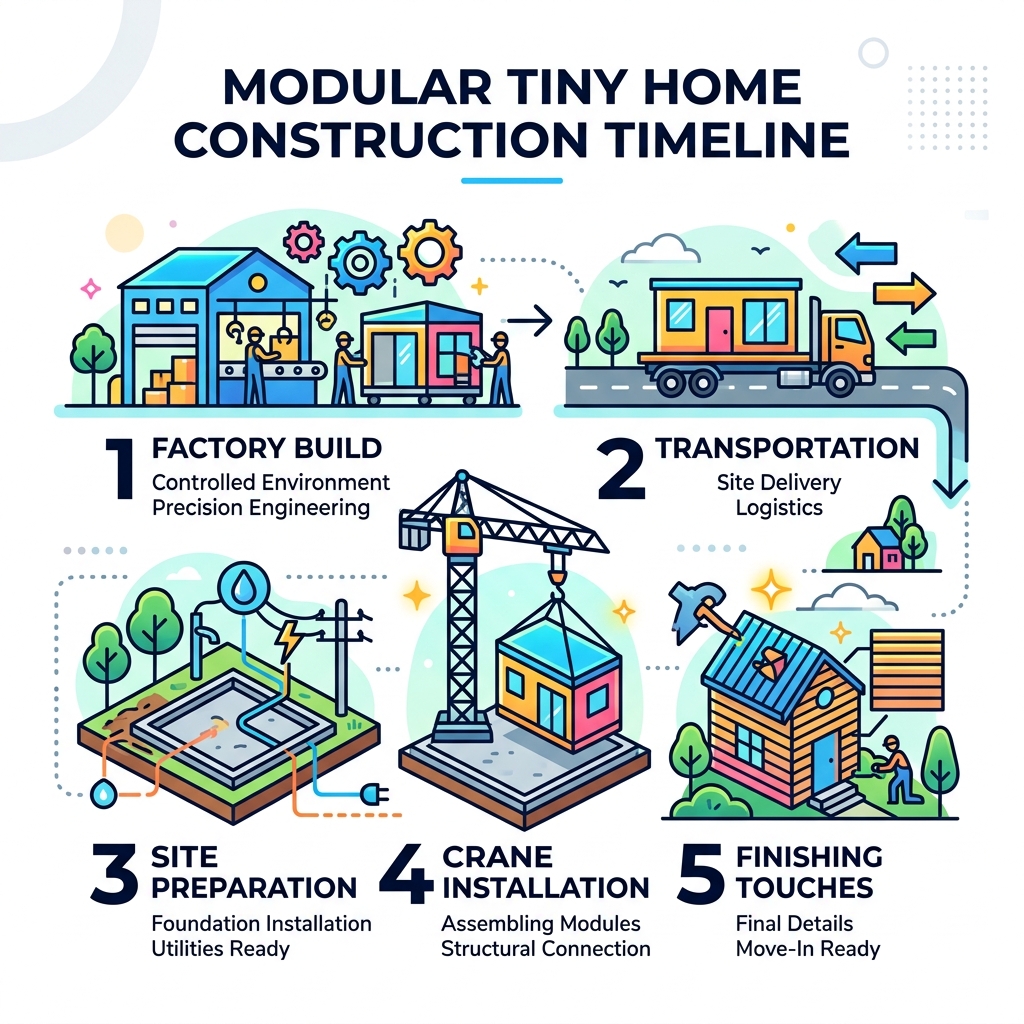
Logistics: Manufacturing, Delivery, and Installation
The logistics of modular tiny home builds are surprisingly streamlined. While a traditional home can take over a year to complete, the average build time for a modular unit is between 4 and 48 weeks.
The process generally follows these steps:
- Design and Permitting: Choosing your model and getting local municipal approval.
- Factory Construction: Your home is built indoors, protected from the elements.
- Site Preparation: While the home is being built, you (or your contractor) prepare the foundation and utilities. Check out our comprehensive guide to creating an eco-friendly home for site prep tips that minimize environmental impact.
- Delivery: The home is shipped via flatbed truck. Some units, like expandable models, can be set up in under an hour. Others require a crane to lift them onto a permanent foundation.
- Installation and Hookups: Once positioned, local contractors connect the plumbing, electrical, and HVAC systems.
Costs, Financing, and Real-World Use Cases
How much does it cost to join the minimalist movement? The price range is broad, but the average starting price for a quality tiny home is around $50,000. On the lower end, you can find expandable container units for roughly $27,000. On the luxury end, a two-story, 855-square-foot modular home can reach $300,000 USD.
Factors influencing cost include the number of modules, the level of customization, and whether you require an off-grid package (solar, composting toilets, etc.). For a deeper look at budgeting for a sustainable lifestyle, see our comprehensive guide to making your home green.
Common Use Cases:
- Accessory Dwelling Units (ADUs): Perfect for a backyard guest house or “mother-in-law” suite.
- Workforce Housing: Scalable solutions for businesses needing to house employees in high-cost areas.
- Vacation Rentals: High-design models are specifically marketed as “Airbnb-ready” showstoppers.
- Off-Grid Living: Many manufacturers offer custom water and electric packages for remote land.
Frequently Asked Questions about Modular Tiny Homes
What building codes apply to modular tiny homes?
Modular tiny homes are typically built to the International Residential Code (IRC), which is the same standard used for traditional single-family homes. This differs from manufactured homes (HUD code) or RVs (ANSI standards). Always check your local municipal standards, as some regions have specific requirements for wind ratings (especially in Florida) or snow loads.
How long does the setup process take once delivered?
The “unboxing” experience varies by model. An expandable container home can be structurally “set up” in about an hour. However, a full modular installation—including crane service, anchoring to a foundation, utility hookups, and interior finishing—usually takes 1 to 2 weeks on-site.
Conclusion
Transitioning to a minimalist lifestyle doesn’t have to mean sacrificing quality or comfort. Modular tiny home builds offer a sophisticated, sustainable, and legally secure way to downsize. Whether you’re looking for a backyard ADU or a remote off-grid sanctuary, the modular industry has evolved to meet almost any requirement.
What makes this housing option especially compelling is the balance it offers between simplicity and permanence. You can reduce square footage, utility consumption, and maintenance demands while still enjoying a home that is engineered to modern residential standards. For many buyers, that combination is the real appeal: a smaller home that still feels stable, intentional, and future-friendly.
Modular construction also gives homeowners more predictability than many conventional builds. Factory assembly, clearer timelines, and repeatable quality-control processes can make the journey less stressful from planning through installation. That matters whether you are creating a private retreat, adding flexible living space for family, or building a property with long-term rental potential.
At Refugio do Jardim, we believe that the future of housing is efficient, beautiful, and kind to the planet. By choosing a factory-built modular home, you’re not just buying a house – you’re investing in a smarter way to live. Ready to start your journey? Explore our resources and join the movement toward a more intentional, sustainable future.
