
Stop Exhausting the Planet with Better Travel Habits
Why Transportation Is Draining the Planet — and What You Can Do Right Now
Reducing greenhouse gas emissions from transportation is one of the most impactful things you can do for the planet — and it’s more doable than you think.
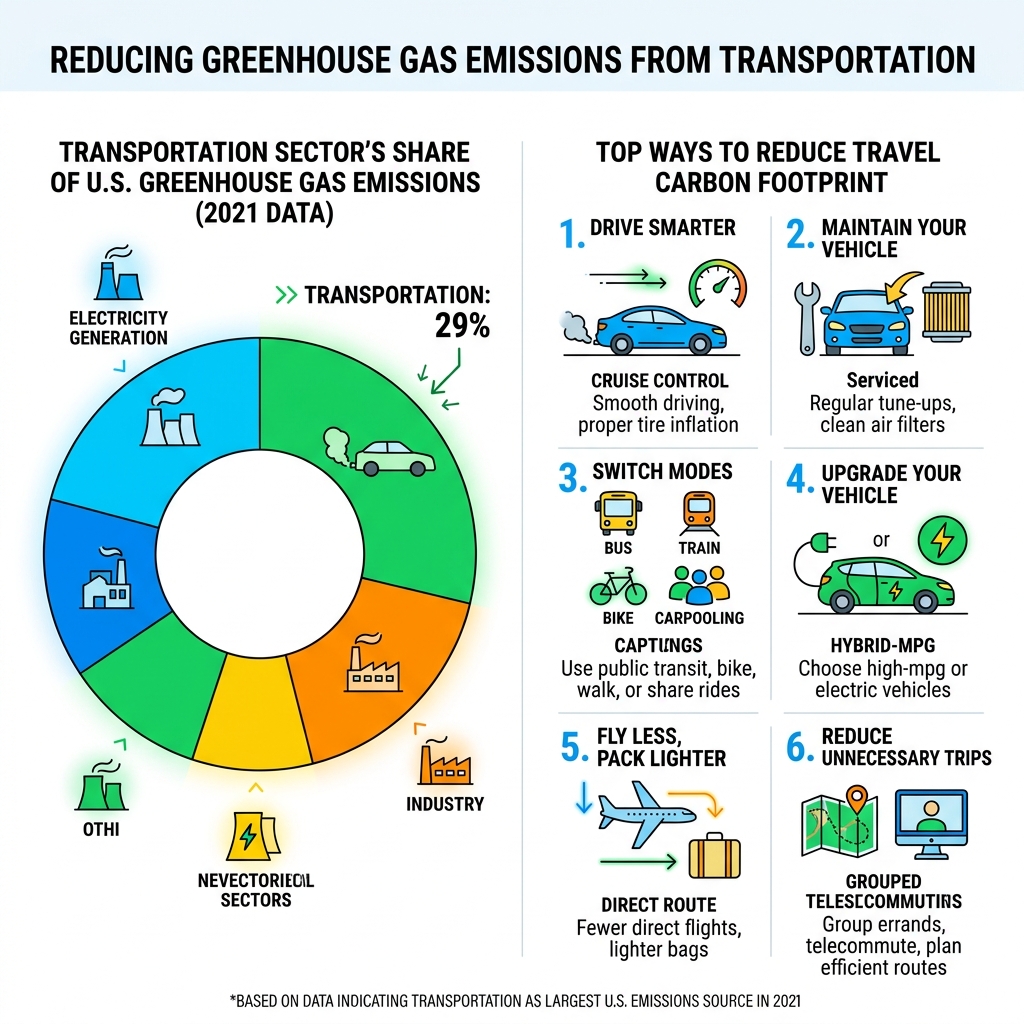
Here’s a quick snapshot of how to cut your travel-related carbon output:
- Drive smarter — avoid hard braking, use cruise control, keep tires inflated
- Maintain your vehicle — tune-ups and clean air filters improve efficiency by up to 4%
- Switch modes — take public transit, bike, walk, or carpool whenever possible
- Upgrade your vehicle — choose a higher-mpg car or go electric
- Fly less, pack lighter — direct flights and lighter bags meaningfully reduce aviation emissions
- Reduce unnecessary trips — group errands, telecommute, and plan smarter routes
Now, here’s why this matters so much.
Every single gallon of gasoline you burn releases over 20 pounds of carbon dioxide into the atmosphere. The average car does that enough times each year to produce 6 to 9 tons of CO2 — just from one vehicle, one household.
Scale that up, and it’s no surprise that transportation is the largest source of greenhouse gas emissions in the United States, accounting for roughly 29% of total U.S. emissions as of 2021. That’s more than electricity generation, more than industry, more than anything else.
And without changes, it’s only going to grow.
The good news? Small, consistent choices add up fast. Switching from a 20-mpg to a 25-mpg vehicle alone cuts your annual emissions by 1.7 tons. Swapping a 20-mile daily car commute for public transit can shave 4,800 pounds of CO2 off your yearly footprint.
You don’t need to overhaul your life. You just need a plan.
The Blueprint for Reducing Greenhouse Gas Emissions from Transportation
To tackle a problem as big as global warming, we need more than just individual effort; we need a roadmap. The U.S. government has developed exactly that: the U.S. National Blueprint for Transportation Decarbonization. This isn’t just a fancy document for scientists; it’s a strategy designed to get us to a net-zero greenhouse gas economy by 2050.

The Blueprint is built on three main pillars: Convenience, Efficiency, and Clean. Think of these as the three levers we can pull to stop exhausting the planet.
1. Convenience: Travel Less, Live More
The “Convenience” strategy is all about land-use planning. If we build our communities so that work, school, and the grocery store are closer to home, we don’t have to drive as much. This reduces “Vehicle Miles Traveled” (VMT). By prioritizing transit-oriented development, we can make it so that the most convenient choice is also the greenest.
2. Efficiency: Getting More from Every Drop (or Volt)
The “Efficiency” strategy focuses on the energy intensity of our travel. Even if we still need to drive or ship goods, we can do it using less energy. This includes everything from better aerodynamics on trucks to smarter flight paths for airplanes. It’s about making sure that every ounce of fuel or kilowatt of electricity takes us as far as possible.
3. Clean: Switching the Fuel Source
Finally, the “Clean” strategy focuses on the carbon intensity of our fuels. This is where electric vehicles (EVs), hydrogen fuel cells, and sustainable biofuels come in. The goal is to transition away from fossil fuels entirely.
Why do we need this? Because history shows that as our population grows, we tend to drive more. In the past, improvements in fuel economy were often canceled out because people simply drove more miles. To truly win, we have to use all three strategies at once. You can learn more about how these are measured by visiting the EPA’s guide on Evaluating GHG Reduction Measures – Transportation Sector | US EPA.
Master the Art of Eco-Driving and Vehicle Maintenance
Most of us aren’t going to stop driving tomorrow. But did you know that how you drive can change your carbon footprint as much as what you drive? Mastering “eco-driving” is like giving your car a software update through your right foot.
The Golden Rules of Eco-Driving
- Gentle on the Pedals: Hard acceleration and slamming on the brakes aren’t just stressful; they’re fuel killers. Rapid starts and stops can lower your gas mileage by a whopping 33% on the highway and 5% around town. Imagine there’s an egg under your gas pedal that you don’t want to crack.
- The 60 MPH Rule: Most cars reach peak fuel efficiency at speeds below 60 mph. For every 5 mph you drive over 60, you’re essentially paying an extra $0.20 to $0.50 per gallon of gas.
- Use Cruise Control: On flat terrain, cruise control helps maintain a constant speed, which is much more efficient than constant micro-adjustments by a human foot.
- Stop the Idling: If you’re going to be stopped for more than 30 seconds (and you’re not in traffic), turn off the engine. Idling can burn a quarter to a half-gallon of fuel per hour. Modern engines don’t need “warming up” like cars from the 1970s did.
Maintenance Matters
A neglected car is a thirsty car. Simple maintenance can provide a 4% boost in fuel efficiency.
- Tire Inflation: Under-inflated tires have more rolling resistance. It’s like trying to ride a bike with soft tires — it’s much harder work! Check your pressure monthly.
- Clean Air Filters: If your engine can’t breathe, it can’t burn fuel efficiently.
- Regular Tune-ups: Fixing a car that is noticeably out of tune or has failed an emissions test can improve its gas mileage by an average of 4%.
For more deep-dive tips on keeping your car eco-friendly, check out our gassing-down-the-essential-guide-to-mitigating-your-carbon-footprint.
Improving Fuel Efficiency for Daily Commutes
Your daily commute is likely your biggest source of regular emissions. If you’re in the market for a new car, the difference between 20-mpg and 25-mpg might seem small, but it saves 1.7 tons of CO2 every year.
If you can’t change your car, change your route. Route optimization apps can help you avoid stop-and-go traffic, which is the enemy of efficiency. In some areas, programs like Commute Smart NH offer resources to help commuters find better ways to get to work. We’ve put together a list of green-commuting-ideas to help you rethink that morning drive.
Shifting to Low-Carbon Modes of Travel
Sometimes the best way to reduce emissions from a car is to not be in a car at all. Shifting to “higher-occupancy” modes of travel is one of the most effective ways of reducing greenhouse gas emissions from transportation.
The Power of Public Transit
Public transportation is a carbon-cutting machine. A 20-mile round trip commute switched from a private car to public transit can lower your annual carbon footprint by 4,800 pounds. That’s because buses and trains move dozens or hundreds of people using much less energy per person than a single-occupant vehicle.
In fact, communities with strong public transportation systems reduce U.S. carbon emissions by 37 million metric tons every year. It’s not just about the environment, either. Individuals can save over $9,700 a year by ditching the car for a transit pass.
Freight and Long-Distance Travel
It’s not just about how we move, but how our stuff moves. Rail and maritime transport are vastly more efficient than trucking.
| Transport Mode | GHG Emissions per Ton-Mile (Compared to Trucking) |
|---|---|
| Freight Rail | 78% Lower |
| Ocean-Going Vessels | 82% Lower |
| Barge / Inland Marine | 89% Lower |
When you choose to ship items via slower, more efficient methods, or when you travel via intercity rail (like Amtrak) instead of flying or driving, you are making a massive dent in your footprint. Amtrak’s network is about 33% more energy-efficient than flying. For more on how to travel responsibly, see our eco-conscious-travel-tips.
Active Transportation and Reducing Greenhouse Gas Emissions from Transportation
Active transportation — walking, biking, and “micromobility” (like e-scooters) — produces zero operational emissions.
Many cities are adopting the “Complete Streets” philosophy. This means designing roads for everyone, not just cars. When we build protected bike lanes and wide sidewalks, people feel safe enough to leave the car at home.
- Biking: For short trips (under 3 miles), biking is often just as fast as driving once you account for parking.
- Walking: Trips of less than one mile are perfect opportunities to get some steps in and save 20 pounds of CO2 per gallon of gas not burned.
- Micromobility: E-bikes are a game-changer for people who have longer commutes or live in hilly areas. They provide the “boost” needed to make biking a viable daily option.
Programs like EcoBici in Mexico City have shown that when you make bikes available and affordable, people use them by the millions. This is the heart of transit-oriented development: making it easy to live a full life without needing a two-ton metal box for every errand.
Embracing Electric Vehicles and Sustainable Fuels
We are currently in the middle of the biggest transportation revolution since the horse and buggy were replaced by the Model T. Electric Vehicles (EVs) are the cornerstone of a clean transportation future.
Why EVs are Winning
Even when you account for the electricity used to charge them, EVs typically produce far fewer emissions than gasoline cars. As we “decarbonize the grid” (switching from coal and gas power plants to wind and solar), EVs get cleaner every single day.
The U.S. is currently building out the National Electric Vehicle Infrastructure (NEVI) program, which is investing billions to ensure you can find a charger as easily as a gas station. If you’re worried about range, most daily drives are only 26–32 miles — well within the range of even the most basic EV.
Beyond the Battery: SAF and Hydrogen
Some things are hard to run on batteries, like long-haul airplanes and massive cargo ships. For these, we are looking at:
- Sustainable Aviation Fuels (SAF): These are “drop-in” fuels made from renewable resources that can be used in existing jet engines.
- Hydrogen Fuel Cells: These emit only water vapor and are a promising solution for heavy-duty trucks and buses.
The EPA provides great resources on What You Can Do About Climate Change — Transportation | US EPA if you’re looking to make the switch.
Policy Drivers for Reducing Greenhouse Gas Emissions from Transportation
While individual choices are great, government policies are the “engine” driving these changes.
- CAFE Standards: These regulations require car manufacturers to make vehicles that meet minimum fuel economy standards.
- EPA 2027-2032 Regulations: These new standards are expected to avoid over 7 billion tons of GHG emissions.
- The Bipartisan Infrastructure Law: This is pouring billions into rail, transit, and EV charging.
These policies help lower the cost of green technology for everyone. We’ve even looked at how these changes intersect with your life at home in our guide on reducing-carbon-footprint-at-home.
Frequently Asked Questions about Travel Emissions
Why is transportation the largest source of US greenhouse gas emissions?
In the past, the power sector (electricity) was the biggest polluter. However, as we’ve switched many power plants to natural gas and renewables, the electricity sector’s emissions have dropped. Meanwhile, Americans are driving more miles than ever, and we have a strong preference for larger, less efficient vehicles like SUVs and trucks. This combination pushed transportation to the #1 spot in 2017.
How much CO2 does one gallon of gasoline produce?
It sounds like magic, but a gallon of gas (which weighs about 6 pounds) produces about 20 pounds of CO2. This happens because the carbon in the gasoline combines with oxygen from the air during combustion, significantly increasing the weight of the resulting gas.
What are the three main strategies of the National Blueprint for Transportation Decarbonization?
The three strategies are Convenience (planning communities so people need to travel less), Efficiency (using less energy to move people and goods), and Clean (using zero-emission vehicles and fuels).
Conclusion: A Greener Path Forward
Reducing greenhouse gas emissions from transportation isn’t just about “saving the planet” in an abstract way. It’s about creating better lives for all of us right now.
When we reduce our reliance on fossil-fuel-burning cars, we get:
- Better Air Quality: Fewer tailpipes mean less smog and fewer asthma attacks, especially for children.
- Improved Health: Walking and biking more leads to better cardiovascular health.
- Cost Savings: Lower fuel bills and fewer car maintenance costs mean more money in your pocket.
- Energy Security: Using domestic renewable energy for our cars makes us less dependent on global oil markets.
- Equity: Better public transit helps people who can’t afford a car get to jobs and services reliably.
At Refugio do Jardim, we believe that every small change in your travel habits is a seed planted for a more sustainable future. Whether you decide to inflate your tires today, carpool tomorrow, or buy an EV next year, you are part of the solution.
Start your journey to a greener lifestyle today and let’s stop exhausting the planet, one mile at a time.
