
How to Drive Green and Save Money
Why Eco Friendly Driving Habits Save You Money and the Planet
Eco friendly driving habits are simple, everyday changes to how you drive that reduce fuel consumption, cut costs, and lower your carbon footprint.
Here’s a quick overview of the most impactful habits:
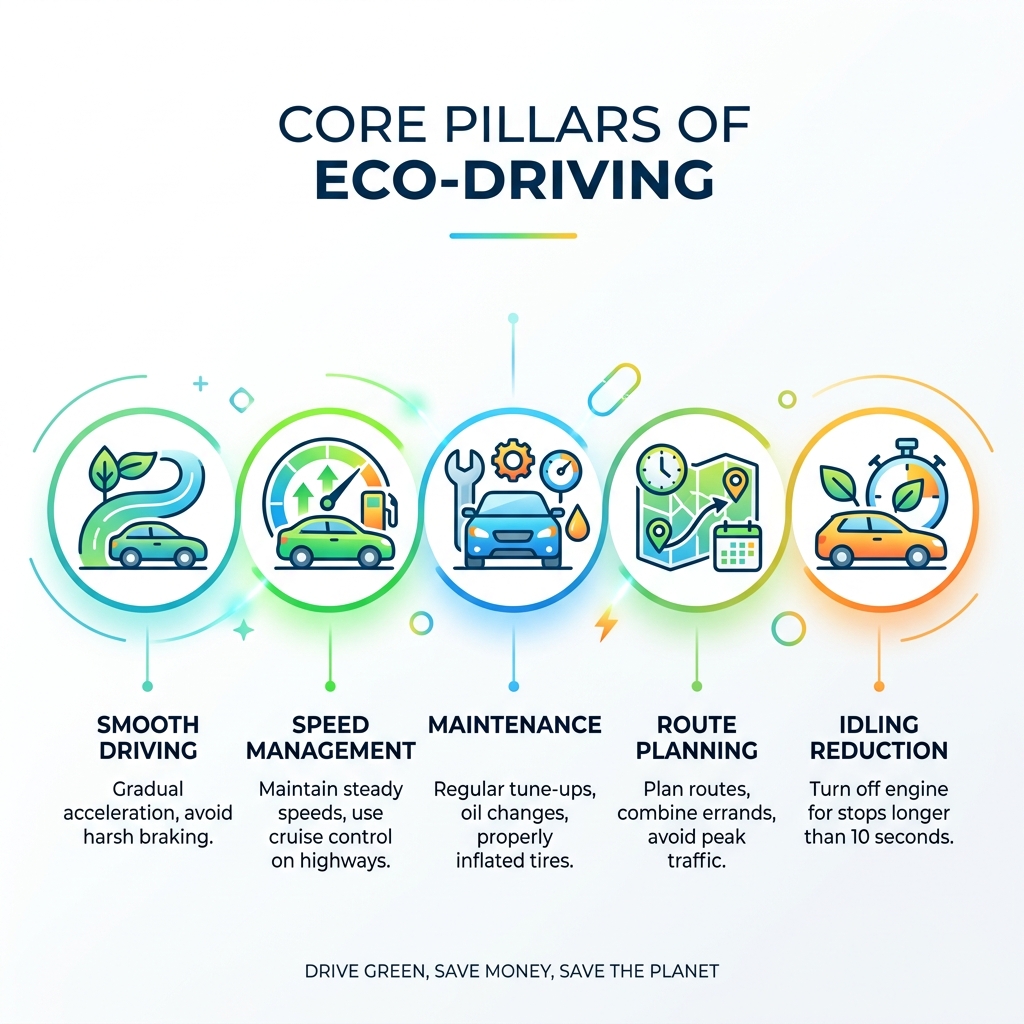
- Drive smoothly – avoid rapid acceleration and harsh braking
- Maintain steady speeds – use cruise control on highways
- Keep tires properly inflated – improves fuel economy by up to 3%
- Avoid idling – turn off your engine after 10 seconds of stopping
- Remove excess weight – clear your trunk and remove roof racks when not in use
- Plan your routes – combine errands and avoid peak traffic
- Stay on top of maintenance – regular tune-ups, oil changes, and tire checks
Most people think reducing their environmental impact means buying a new car or making expensive lifestyle changes. It doesn’t.
The truth is, how you drive matters just as much as what you drive. Small shifts in driving behavior can cut fuel use by 10–40%, depending on conditions. That translates directly to money back in your pocket — and less CO2 in the atmosphere.
Eco-driving as a concept has been around since 1998, when the Swedish National Driving School began teaching it as a formal method. Since then, it’s spread globally — and for good reason. Fuel is expensive. Emissions regulations are tightening. And every driver has more control over both than they might realize.
You don’t need to overhaul your life. You just need to drive a little smarter.
Master the Art of Eco Friendly Driving Habits
When we talk about mastering eco friendly driving habits, we aren’t suggesting you drive like a snail. We are suggesting you drive like a pro. Professional drivers, especially those in large fleets, are often trained in “smoothness” because it preserves the vehicle and saves a fortune in fuel.
Aggressive driving is the ultimate enemy of your wallet. According to the U.S. Department of Energy research on aggressive driving, behaviors like speeding, rapid acceleration, and hard braking can lower your gas mileage by 15% to 30% at highway speeds. If you are stuck in stop-and-go city traffic, that penalty can skyrocket to 40%.
The goal is to maintain a steady pace. Think of your car like a heavy pendulum; it takes a lot of energy to get it swinging, but very little to keep it moving. Every time you slam on the brakes, you are throwing away all the expensive energy (fuel) you just used to get moving.
Why Smooth Acceleration is a Top Eco Friendly Driving Habit
We’ve all seen that driver who “jackrabbits” away from a red light only to meet us at the next one thirty seconds later. Not only is this stressful, but it’s also incredibly inefficient.
Analysis by the Massachusetts Institute of Technology on driving behavior shows that aggressive acceleration puts an immense load on the engine, forcing it to operate at its least efficient points. When you accelerate gradually, you allow the transmission to shift through gears at optimal RPMs, using the engine’s torque more effectively.
In stop-and-go traffic, the best eco friendly driving habit is to leave plenty of space. Instead of accelerating and braking constantly, try to roll at a slow, steady speed. This preserves kinetic energy and prevents the “start-stop” cycle that gobbles up fuel.

Maintaining Steady Speeds for Maximum Efficiency
Consistency is king. A Natural Resources Canada study on speed fluctuations found that changing your speed back and forth between 75 km/h and 85 km/h (roughly 47 to 53 mph) every 18 seconds can increase your fuel usage by a staggering 20%.
On the highway, your car struggles against wind resistance. Generally, fuel economy decreases rapidly at speeds above 50 mph. For every 5 mph you drive over 50 mph, it’s like paying an additional $0.18 per gallon for gas (based on average fuel costs).
To combat this, we recommend using cruise control on flat terrain. It prevents the “foot fatigue” that leads to unintentional speeding and keeps the engine at a constant, efficient load. However, a word of advice: turn cruise control off in very hilly areas. Sometimes it’s better to let the speed drop slightly as you go uphill rather than forcing the engine to downshift and roar to maintain a precise number.
Optimize Your Vehicle for Peak Performance
Your car is a tool, and like any tool, it works best when it’s in top shape. You could be the smoothest driver in the world, but if your car is fighting against mechanical drag or unnecessary weight, your eco friendly driving habits won’t reach their full potential.
Let’s talk about the “100-pound rule.” For every extra 100 pounds you carry in your vehicle, your fuel economy drops by about 1%. While that sounds small, it adds up over thousands of miles. If your trunk is filled with old sports equipment, tools, or bags of salt you forgot to take out last winter, you are literally paying to transport junk.
Aerodynamics also play a massive role. At highway speeds, over 50% of your engine’s effort goes into simply pushing air out of the way. If you have a roof rack or a cargo box that you aren’t using, take it off. A large, blunt roof box can reduce fuel economy by 2% to 8% in the city and a massive 6% to 25% on the highway.
Essential Maintenance as an Eco Friendly Driving Habit
Maintenance isn’t just about preventing breakdowns; it’s about efficiency. According to properly inflated tires research, keeping your tires at the pressure recommended by the manufacturer can improve your gas mileage by 0.6% on average, and up to 3% in some cases. Under-inflated tires have more “rolling resistance”—they are stickier and harder to turn, making the engine work harder.
The type of oil you use matters, too. Research on fuel economy and motor oil indicates that using the manufacturer’s recommended grade of motor oil can improve fuel economy by 1% to 2%. Look for oil containers that say “Energy Conserving” on the API performance symbol to ensure it contains friction-reducing additives.
Finally, don’t ignore the “Check Engine” light. A car that is noticeably out of tune or has failed an emissions test can see a 4% improvement in mileage once fixed. In extreme cases, such as a faulty oxygen sensor, fixing the issue can improve mileage by as much as 40%. You can check the EPA Green Vehicle Guide for more tips on how maintenance impacts your specific vehicle type.
The 10-Second Rule for Avoiding Idling
There is a persistent myth that restarting your car uses more fuel than letting it idle. This might have been true in the days of carburetors, but with modern fuel injection, it’s completely false.
An Argonne National Laboratory idling study found that idling for more than 10 seconds actually uses more fuel than switching the vehicle off and on again. Idling can waste a quarter to a half gallon of fuel per hour.
If you are waiting to pick someone up, sitting at a long train crossing, or waiting in a non-moving drive-thru line, turn the engine off. Not only does this save fuel, but it also reduces engine wear and prevents unnecessary CO2 from entering the atmosphere. Many modern cars now come with “stop-start” technology that does this automatically—if your car has it, leave it on!
Smart Planning and Technology Integration
We often think of driving as a spontaneous activity, but a little bit of planning goes a long way. This is where “trip chaining” comes in. Instead of making three separate trips to the grocery store, the post office, and the gym throughout the day, combine them into one.
Why? Because an engine is at its most efficient when it is warm. Cold starts are hard on the engine and use significantly more fuel as the car works to reach operating temperature. By combining errands, you keep the engine warm for the entire duration of your tasks.
A famous United Parcel Service (UPS) routing case study highlighted how the company saved millions of gallons of fuel by optimizing routes to avoid left-hand turns against traffic, which often led to long periods of idling. While you might not need to ban left turns, using a navigation app to find the most efficient (not just the shortest) route can save you a lot of time and gas.
Transitioning to EVs and Alternative Transport
If you are in the market for a new vehicle, the most effective way to lock in eco friendly driving habits is to choose a fuel-efficient model. Electric Vehicles (EVs) produce zero tailpipe emissions and are incredibly efficient in city traffic thanks to regenerative braking.
Regenerative braking allows the car to capture the kinetic energy usually lost during braking and turn it back into electricity to charge the battery. This makes “one-pedal driving” possible and significantly extends the life of your brake pads.
However, the greenest mile is the one you don’t drive at all. We encourage you to check out Green Commuting Ideas for inspiration on carpooling, public transit, or even biking and walking for short distances. If 20% more people worldwide switched to bikes for short trips, we could see an 11% reduction in total carbon emissions by 2050.
How Technology Supports Eco Friendly Driving Habits
Modern cars are essentially computers on wheels, and they offer incredible tools to help you drive better. Most cars now feature real-time MPG displays. A UC Davis Institute of Transportation Studies feedback study found that drivers who used instantaneous in-vehicle feedback improved their fuel economy by an average of 6.6%.
Many manufacturers include specific “Eco-Modes” that adjust the throttle response and climate control to prioritize efficiency. Systems like Honda’s ECO Assist or Ford’s SmartGauge provide visual cues (like changing colors or growing “digital leaves”) to reward you for smooth driving.
For those managing multiple vehicles, tools like the Alternative Fuel Life-Cycle Tool can help calculate the long-term benefits of switching to alternative fuels or implementing telematics. Telematics allow you to track idling time, harsh braking, and speeding, providing a “scorecard” that can be used to coach drivers toward better habits.
Frequently Asked Questions about Eco-Driving
We know you probably have some specific questions about how these habits work in the real world. Here are some of the most common things we hear at Refugio do Jardim.
How much money can I actually save with eco-driving?
It depends on your current habits, but the savings are substantial. If you switch from aggressive driving to sensible eco friendly driving habits, you can save the equivalent of $0.34 to $0.98 per gallon. Over a year of average driving, that can easily add up to $500–$1,000 in fuel savings alone.
Beyond fuel, you’ll save on maintenance. Smooth driving means your brake pads last longer, your tires wear more evenly, and your engine experiences less stress. Some insurance companies even offer “pay-how-you-drive” discounts if you use a telematics plug-in that proves you are a safe, steady driver.
Do modern cars really need to “warm up” in winter?
In a word: No. Most manufacturers recommend driving off gently about 30 seconds after starting the engine. Modern fuel injection systems adjust to the cold almost instantly.
Idling to “warm up” the car actually takes longer to get the engine to operating temperature than driving does. The fastest way to warm up the engine (and your heater) is to get moving. Just avoid high speeds or heavy acceleration for the first few minutes until the temperature gauge starts to climb.
Is it better to use the AC or roll down the windows?
This is the classic summer debate. At low speeds (city driving), it is usually more efficient to roll down the windows and turn off the air conditioning. The extra work the engine does to run the AC compressor uses more fuel than the slight increase in wind resistance from open windows.
However, at highway speeds (above 55 mph), the opposite is true. Open windows create significant aerodynamic drag, making the car much harder to push through the air. In this case, it’s actually more efficient to roll up the windows and use the AC.
Conclusion
At Refugio do Jardim, we believe that sustainability starts with the small choices we make every day. Adopting eco friendly driving habits isn’t just a way to protect the environment—it’s a way to respect your vehicle and your hard-earned money.
By driving smoothly, keeping your car well-maintained, and using technology to plan your trips, you can significantly reduce your carbon footprint while enjoying a quieter, safer, and more affordable driving experience. Whether you’re driving a classic gas-powered car or a brand-new EV, these principles remain the same: drive smart, stay steady, and be mindful of the road ahead.
Ready to take the next step in your sustainability journey? Start your green lifestyle journey with us today and discover more ways to live in harmony with the planet. Safe travels!
