
A Complete Air Purifier Plants List for Your Home
Your Home’s Air May Be More Polluted Than You Think
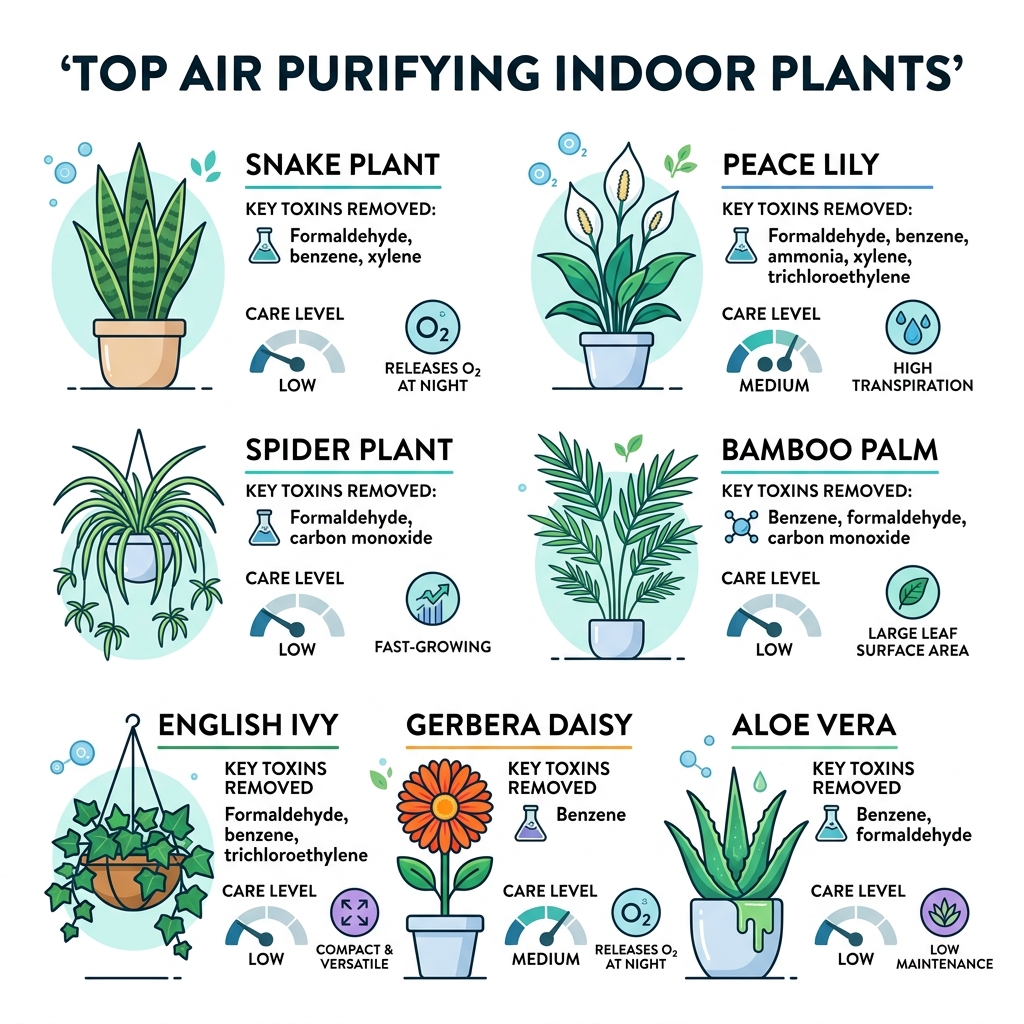
Air purifying indoor plants for oxygen are one of the simplest, most affordable ways to improve the air quality in your home. Here are the top options, backed by NASA research:
| Plant | Key Toxins Removed | Oxygen Bonus |
|---|---|---|
| Snake Plant | Formaldehyde, benzene, xylene | Releases O2 at night |
| Peace Lily | Formaldehyde, benzene, ammonia, xylene, trichloroethylene | High transpiration |
| Spider Plant | Formaldehyde, carbon monoxide | Fast-growing, prolific |
| Bamboo Palm | Benzene, formaldehyde, carbon monoxide | Large leaf surface area |
| English Ivy | Formaldehyde, benzene, trichloroethylene | Compact and versatile |
| Gerbera Daisy | Benzene | Releases O2 at night |
| Aloe Vera | Benzene, formaldehyde | Low maintenance |
Most of us spend around 90% of our time indoors. Yet the air inside our homes can actually be more polluted than outside. Everyday items like carpets, furniture, paint, and cleaning products quietly release chemicals called volatile organic compounds (VOCs) — including formaldehyde, benzene, and xylene.
The good news? A handful of common houseplants can help.
NASA scientists studied this exact problem. Their landmark Clean Air Study found that certain indoor plants are remarkably effective at absorbing these toxins — so effective, in fact, that researchers considered using plants as part of biological life support systems on space stations.
For a busy person looking for a small change with real impact, a few well-chosen plants on your windowsill or desk is about as low-effort as it gets.
How Air Purifying Indoor Plants for Oxygen Work
It might seem like magic, but the way plants clean our air is grounded in fascinating biology. At the most basic level, we all remember photosynthesis from school: plants take in carbon dioxide and light to produce energy, releasing fresh oxygen as a byproduct. However, air purifying indoor plants for oxygen do much more than just “breathe” for us.
The process of phytoremediation is where the real heavy lifting happens. Plants absorb air through tiny pores on their leaves called stomata. Along with the air, they pull in invisible toxins like formaldehyde and benzene. Once inside, these chemicals travel down to the roots. Here, specialized soil micro-organisms break down the pollutants, turning them into food for the plant. It is a perfect, waste-free recycling system!
Another key mechanism is transpiration. As plants release moisture into the air, they create a tiny “pump” effect that pulls air down toward the root zone. This moisture also acts as a natural humidifier, which can help soothe dry skin and respiratory passages during the winter months. By making your home green, you aren’t just decorating; you are installing a living, breathing filtration system.
Top NASA-Recommended Plants for Cleaner Air
When NASA conducted its famous Clean Air Study, they weren’t looking for the prettiest flowers; they were looking for the most efficient chemical scrubbers. They discovered that tropical plants are particularly good at this because they evolved to process gases efficiently even in the low light of dense jungle canopies.
| Plant Name | Primary Toxins Removed | Light Needs | Difficulty |
|---|---|---|---|
| Snake Plant | Benzene, Formaldehyde, Trichloroethylene | Low to Bright | Easy |
| Peace Lily | Ammonia, Benzene, Formaldehyde, Xylene | Medium Indirect | Moderate |
| Spider Plant | Carbon Monoxide, Formaldehyde, Xylene | Bright Indirect | Easy |
| English Ivy | Fecal particles, Formaldehyde, Benzene | Bright Indirect | Moderate |
| Bamboo Palm | Formaldehyde, Xylene, Chloroform | Bright Indirect | Easy |
| Dracaena | Benzene, Formaldehyde, Trichloroethylene | Bright Indirect | Moderate |
Snake Plant: The Nighttime Air Purifying Indoor Plant for Oxygen
The Snake Plant (Dracaena trifasciata), also humorously known as “Mother-in-Law’s Tongue,” is a true superhero in the plant world. Most plants stop producing oxygen at night because they need sunlight for photosynthesis. However, the Snake Plant uses a special process called Crassulacean Acid Metabolism (CAM).
During the day, it keeps its stomata closed to conserve water. At night, it opens them wide to take in CO2 and release a fresh burst of oxygen. This makes it the absolute best choice for bedrooms, as it works overtime while you sleep. Beyond its breathing habits, scientific research on Sansevieria Trifasciata health properties suggests it can decrease detectable VOCs in a room by up to 87% within just 24 hours.

Best of all, these plants are nearly indestructible. They thrive on neglect, meaning you only need to water them every few weeks when the soil is bone-dry. If you are a beginner, this is your starting point.
Peace Lily: The Ultimate Toxin Filter
If the Snake Plant is the “easy-goer,” the Peace Lily (Spathiphyllum) is the “overachiever.” It earned a top ranking in NASA’s study because it removes five of the most common and dangerous indoor toxins: formaldehyde, benzene, trichloroethylene, xylene, and even ammonia (often found in window cleaners).
Peace Lilies are also excellent at humidity regulation. They can increase a room’s humidity by up to 5%, which is great for suppressing airborne microbes that thrive in dry air. One of our favorite features is that they “talk” to you. When they are thirsty, their leaves will visibly droop. Once you give them a drink, they perk back up within hours.
According to scientific research on growing peace lilies, they prefer bright, indirect light. Be careful, though—their beautiful white spathes and dark leaves contain calcium oxalate crystals, which can be toxic if nibbled by pets or curious children.
Spider Plant: Easy Air Purifying Indoor Plants for Oxygen
The Spider Plant (Chlorophytum comosum) is a classic for a reason. It is incredibly effective at filtering out carbon monoxide and formaldehyde. In fact, research shows that a few Spider Plants can remove 90% of the formaldehyde in a small room in less than two days.
For those interested in nature-inspired living, the Spider Plant offers a unique aesthetic with its arching leaves and “babies” (plantlets) that dangle from the mother plant. These babies are very easy to propagate; simply snip them off and place them in water or soil to grow a whole new air purifier for free!
Essential Care and Placement for Maximum Efficiency
To get the most out of your air purifying indoor plants for oxygen, you can’t just stick them in a dark corner and forget them. Efficiency is tied to the plant’s health.
- The “Power of 15” Rule: For a home of about 2,000 square feet, studies suggest you need at least 15 healthy plants in 6-inch pots (or larger) to see a significant drop in toxin levels.
- One Plant Per 100 Square Feet: If you live in a smaller apartment, aim for at least one plant for every 100 square feet of living space.
- Light and Airflow: Plants need light to fuel the photosynthesis that creates oxygen. Place them near windows or under grow lights. Also, ensure there is some airflow in the room so the plants can actually “reach” the air they need to clean.
- Keep Leaves Dust-Free: Dust can clog the stomata (pores) on the leaves, making it harder for the plant to absorb toxins and release oxygen. Wipe leaves with a damp cloth every few weeks.
- Proper Drainage: Most air-purifying plants, especially the Snake Plant and Peace Lily, hate “wet feet.” Ensure your pots have drainage holes to prevent root rot.
Frequently Asked Questions about Indoor Air Quality
How effective are plants at purifying indoor air?
While a single plant won’t replace a high-end HEPA air purifier for removing dust or pollen, they are incredibly effective at removing gaseous chemicals (VOCs) that mechanical filters often miss. Beyond just chemical removal, plants provide psychological benefits, reducing stress and boosting productivity by up to 15% in office settings. They are a continuous, natural filtration system that works 24/7.
Which plants are safe for homes with pets and children?
Safety is a common concern. Many popular plants, like the Peace Lily and Philodendron, contain calcium oxalate crystals, which cause mouth irritation and digestive upset if eaten. If you have pets or toddlers, we recommend sticking to “safe” options like:
- Spider Plants
- Boston Ferns
- Bamboo Palms
- Areca Palms
Always double-check the toxicity of a plant before bringing it into a home with furry friends.
How many plants are needed for a 2,000 square foot home?
As mentioned, the NASA-backed recommendation is roughly 15 to 18 plants for a 2,000 square foot area. However, density matters more than just the total count. We suggest grouping plants together. Not only does this look beautiful, but it also creates a “micro-environment” with higher humidity and more concentrated air-cleaning power. Try placing three plants in your bedroom (including a Snake Plant for that nighttime oxygen) and another four in the living room where you spend the most time.
Conclusion
At Refugio do Jardim, we believe that a home should be a sanctuary. Integrating air purifying indoor plants for oxygen is a cornerstone of a sustainable lifestyle. These green companions do more than just sit on a shelf; they actively work to lower our stress, improve our sleep, and protect our long-term respiratory health.
Whether you start with a single, hardy Snake Plant or transform your living room into a lush botanical retreat, you are making a choice for a cleaner, healthier future. Plants are a reminder that nature has already provided the solutions to many of our modern problems—we just need to bring them inside.
Happy planting, and breathe easy!
