
Ditch the Traffic and Save the Earth with Public Transit
Why Most Commuters Are Choosing Public Transit Over Driving
Why should we use public transport instead of personal vehicles is one of the most practical questions anyone trying to live greener can ask — and the answer is simpler than you might think.
Here’s a quick summary:
| Reason | Key Benefit |
|---|---|
| Environment | Reduces your carbon footprint by up to 45% vs. driving alone |
| Cost | Saves households over $10,000 per year by eliminating one car |
| Health | Builds daily walking into your routine — no gym needed |
| Safety | Public transit is over 10 times safer per mile than driving |
| Traffic | One full bus removes up to 30 cars from the road |
| Equity | Connects people of all ages and incomes to jobs and services |
If you’re a busy city dweller already overwhelmed by environmental headlines, here’s the good news: switching to public transit is one of the highest-impact, lowest-effort changes you can make.
You don’t need to overhaul your life. You just need to swap your commute.
Think about the last time you sat in bumper-to-bumper traffic, watching the minutes tick by. Anyone who drives during rush hour knows that stress well. Now imagine that same trip — but you’re reading, listening to a podcast, or simply sitting back — while your commute also happens to cut your household carbon emissions by nearly half.
That’s the real case for public transit. It’s not just better for the planet. It’s better for your wallet, your health, and your daily sanity.
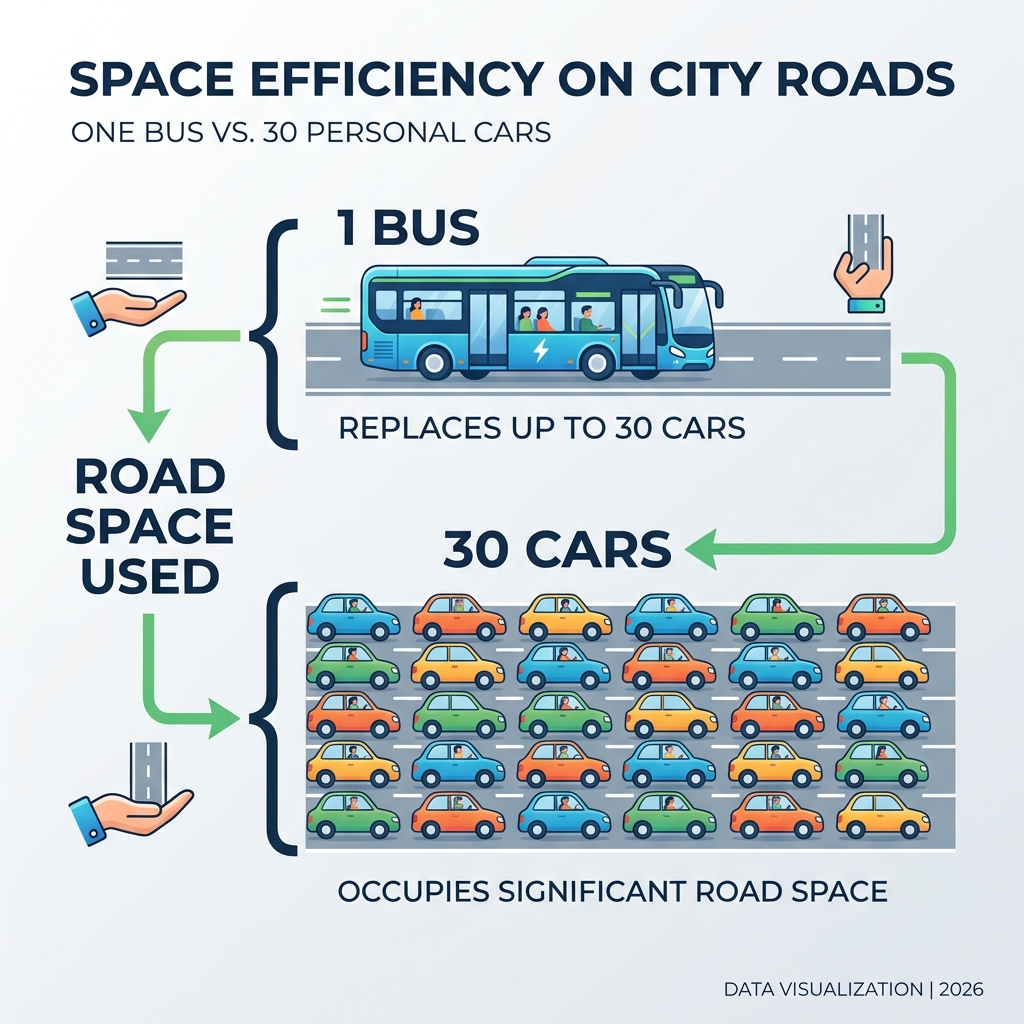
Environmental Impact: Why should we use public transport instead of personal vehicles?
When we talk about the health of our planet, transportation is often the elephant in the room. In fact, approximately 85% of greenhouse gas emissions from the transportation sector are linked to our surface transportation systems. Most of these emissions come from the tailpipes of private cars carrying just one or two people.
Why Is Using Public Transport Good for the Environment? The answer lies in the sheer efficiency of shared travel. Public transit acts as a massive carbon vacuum for our cities. By consolidating dozens of travelers into a single vehicle, we drastically reduce the amount of fuel burned per person. In the U.S. alone, public transportation saves 37 million metric tons of carbon dioxide annually. To put that in perspective, that is equivalent to the electricity used by 4.9 million households!
Beyond just carbon, personal vehicles are major contributors to air pollution, releasing nitrogen oxides and particulate matter that cloud our skies and damage our lungs. Public transit helps clear the air, reducing smog and even fighting the “urban heat island” effect. By replacing vast parking lots with green spaces and transit hubs, we can create cooler, more breathable cities.

Reducing Your Carbon Footprint with Every Ride
If you are looking for green-commuting-ideas, switching from a solo drive to a bus or train is your “silver bullet.” Research shows that using public transport can reduce an individual’s carbon footprint by a staggering 45% compared to driving alone.
Consider this: a single person switching from a 20-mile solo car commute to public transportation can reduce their annual CO2 emissions by 48,000 pounds. That is a 10% reduction in the total greenhouse gases produced by a typical two-car household. This works because of the “passenger-load factor”—the more people on the bus, the lower the environmental “cost” for each person. While a car is a 2-ton machine moving one person, a subway train can replace hundreds of cars, making it the ultimate tool for climate change mitigation.
Economic Advantages for You and Your Community
Let’s talk about the “car tax” we all pay—not the government kind, but the thousands of dollars we bleed every year just to keep a personal vehicle running. Between high fuel prices, skyrocketing insurance premiums, and the inevitable “check engine” light, owning a car is a massive drain on your financial freedom.
| Expense Category | Average Monthly Car Cost | Public Transit Pass |
|---|---|---|
| Fuel | $400 – $600 | Included |
| Insurance | $130 – $150 | Included |
| Maintenance/Tires | $100 – $200 | Included |
| Parking | $100 – $300 | Included |
| Total | $730 – $1,250 | $100 – $150 |
The math is hard to ignore. Each family that gets rid of just one car and relies on public transit can save over $10,000 per year. That is money that could go toward a home down payment, a dream vacation, or your retirement fund.
But the benefits aren’t just personal; they’re communal. Public transit is a powerhouse for local economies. For every $10 million invested in transit, we see $30 million in increased business sales. It creates local jobs that can’t be outsourced and boosts property values—residential properties near high-frequency transit are often 42% more valuable.
Why should we use public transport instead of personal vehicles for financial freedom?
If you feel like your paycheck is disappearing before you even see it, look at your driveway. The average household can save up to $1,182 per month by making the switch. This isn’t just about gas; it’s about the hidden costs like depreciation. The second you drive a car off the lot, it starts losing value. A transit pass, however, never loses its utility.
Many employers also offer commuter tax benefits, allowing you to pay for your transit passes with pre-tax dollars. This increases your take-home pay while providing you with reliable economic mobility. For low-income individuals, public transit is a lifeline, improving access to employment opportunities by up to 25%.
Health, Safety, and Social Well-being
We often think of commuting as “dead time,” but public transit turns it into “active time.” Most transit riders walk to and from their stops, easily hitting the 30-minute daily physical activity goal recommended by doctors. In cities like Charlotte, NC, residents who switched to light rail were found to walk significantly more and even lose weight compared to their driving days.
Beyond physical health, there is the mental health aspect. Driving in heavy traffic is a leading cause of daily stress. When you use public transport, you can read, nap, or catch up on emails. This reduction in “steering wheel rage” leads to a happier disposition and more productivity throughout the day.
Safety is another major factor. The National Safety Council reports that millions of car accidents occur each year. However, public transportation is over 10 times safer per mile than traveling by car. By taking high-risk drivers off the road and utilizing professionally trained operators, transit systems significantly lower traffic fatality rates. This is the “Vision Zero” philosophy in action—creating a world where road deaths are a thing of the past.
Why should we use public transport instead of personal vehicles to improve community equity?
Public transit is the great equalizer. It provides Benefits of Using Public Transport Over Personal Vehicles that go far beyond the individual. It offers freedom to those who cannot drive—children, the elderly, and people with disabilities—ensuring they aren’t trapped in their homes.
By connecting diverse neighborhoods, public transit reduces spatial segregation and fosters community interaction. It’s hard to feel connected to your neighbors when you’re encased in a glass and metal box. On a bus or train, you share space with people from all walks of life, strengthening the social fabric of our cities.
Future Innovations and Smart Urban Mobility
The future of transit looks nothing like the clunky, loud buses of the past. We are entering an era of “Smart Urban Mobility.” Cities are rapidly adopting electric buses and even hydrogen-powered trains that produce zero tailpipe emissions.
Innovations like Mobility-as-a-Service (MaaS) allow you to plan, book, and pay for your entire trip—including the bus, a shared bike, and a subway ride—through a single app. This solves the “last-mile” problem, making it easier than ever to get from the station to your front door. With real-time tracking and contactless payments, the “inconvenience” of transit is disappearing. We’re even seeing autonomous metros that have been running safely for decades, proving that technology can make our commutes smoother and more reliable.
Frequently Asked Questions about Public Transit
Is public transport really faster than driving in heavy traffic?
In many cases, yes! Dedicated bus lanes and commuter rail lines bypass the gridlock that traps personal vehicles. In the U.S. alone, public transit use results in a reduction of 865 million hours of travel time annually. When you factor in the time spent hunting for parking, transit often wins the race.
How does public transportation improve urban air quality?
By replacing dozens of individual car engines with one high-efficiency or zero-emission motor, we drastically reduce the amount of smog-forming pollutants in the air. This saves 37 million metric tons of CO2 annually and significantly lowers particulate matter, which is a major win for respiratory health, especially for children.
What are the safety advantages of buses and trains over cars?
Public transit is 10 times safer than driving. Transit operators undergo intensive training and are subject to strict federal regulations. Additionally, monitored stations and the “eyes on the street” provided by fellow passengers create a safer environment than being alone on a dark highway.
Conclusion
At Refugio do Jardim, we believe that a sustainable urban future starts with the choices we make every day. Choosing public transit isn’t just about getting from Point A to Point B; it’s an act of environmental stewardship. It’s a way to reclaim your time, your health, and your hard-earned money.
The modal shift away from personal cars and toward collective transit is essential for the health of our planet. Whether you’re taking the subway to work or a bus to the park, you’re contributing to a cleaner, quieter, and more equitable world. Start your journey toward green commuting today and see how much better your daily routine can be!
