
How to Save Energy Without Your Lights Standing Out
Why Your Lighting Choice Matters More Than You Think
energy saving recessed lighting is one of the easiest upgrades you can make to cut your home’s electricity use — without changing how your space looks or feels.
Quick answer: What makes recessed lighting energy-efficient?
- LED technology uses 10–25 watts to match the brightness of 60–100 watt incandescent bulbs
- ENERGY STAR-certified fixtures use up to 90% less energy than traditional options
- Long lifespan — up to 50,000 hours, or roughly 34 years at 4 hours of use per day
- Dimmer compatibility lets you reduce wattage further when full brightness isn’t needed
- Each fixture saves roughly $80 over its lifetime in energy costs
- Canless (integrated LED) designs seal air gaps, reducing heating and cooling loss too
Most people don’t think much about their ceiling lights. They flip a switch, the room lights up, done.
But here’s the thing: lighting accounts for a significant share of your home’s electricity bill, and older recessed fixtures — the kind with traditional incandescent or halogen bulbs — are quietly burning through energy and money every single day.
The good news? Swapping to modern energy saving recessed lighting is one of those rare changes that’s small in effort but big in impact. No lifestyle overhaul. No contractor needed in most cases. Just a smarter bulb — or a slimmer, integrated fixture — doing the same job for a fraction of the cost.
This guide breaks down exactly how these lights work, what to look for, and how to make the switch without any guesswork.
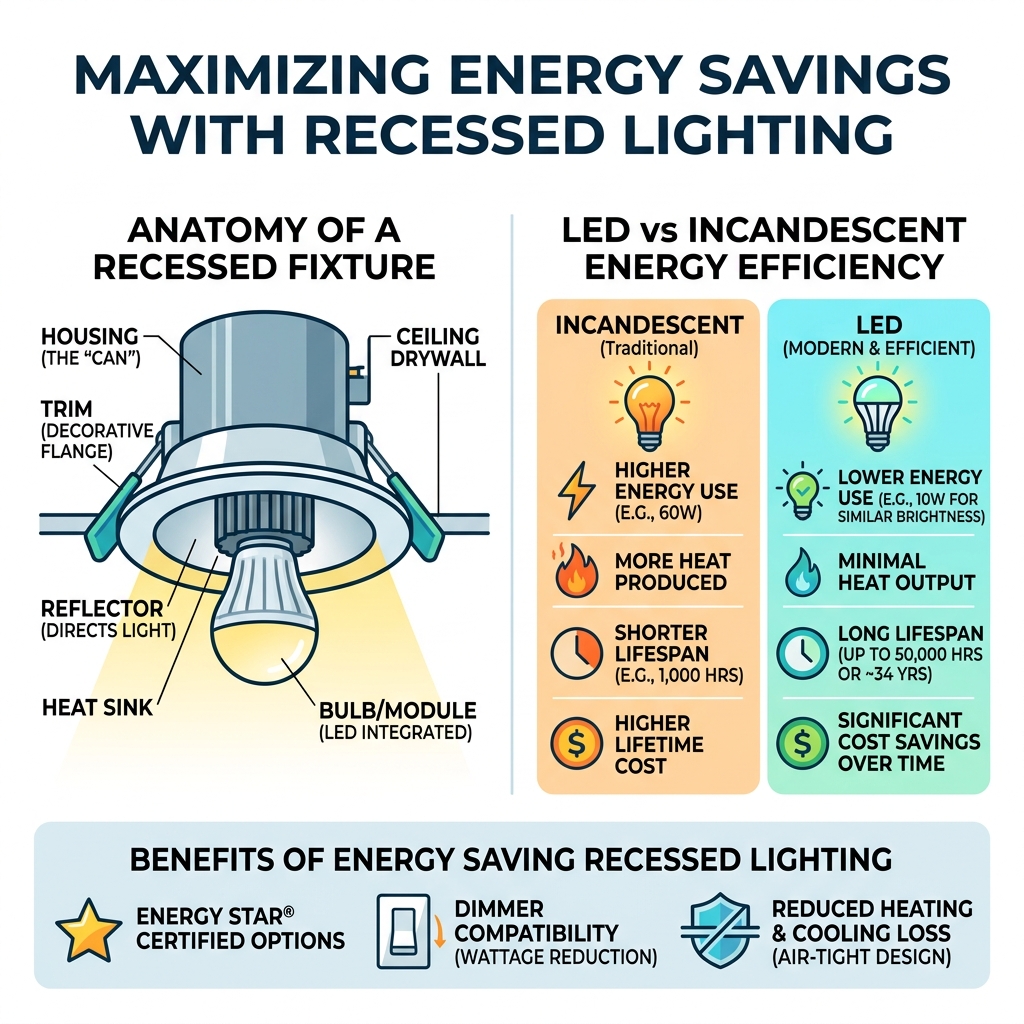
Why Energy Saving Recessed Lighting is the Smart Choice for Modern Homes
When we talk about modern home design, “clean lines” and “minimalism” are the buzzwords of the decade. Recessed lighting, often called “can lights” or “pot lights,” fits this aesthetic perfectly because the bulky parts of the fixture are hidden inside the ceiling. However, the real beauty of energy saving recessed lighting isn’t just how it looks; it’s how it performs.
Traditionally, recessed lights were notorious for being “energy leaks.” Because they require a hole in the ceiling, they often allowed conditioned air to escape into the attic. Modern Recessed Lighting | ENERGY STAR certified fixtures have changed the game. By utilizing LED technology and improved housing designs, we can now enjoy sleek, ambient lighting that actually helps us brighten our homes sustainably.
The Science of LED Efficiency
To understand why these lights are so efficient, we have to look at the “guts” of the fixture. Older incandescent bulbs work by heating a wire filament until it glows. This process is incredibly wasteful; about 90% of the energy used is released as heat, not light.
LEDs (Light Emitting Diodes) are semiconductors. When electricity passes through them, they emit light without needing to get scorching hot. This directional light is perfect for downlighting because it sends the glow exactly where you need it—down toward your floor or workspace—rather than bouncing it around inside a metal “can” where it gets lost. This reduction in thermal waste means your air conditioner doesn’t have to work overtime to fight the heat coming from your ceiling.
Long-Term Financial Benefits
We know that the initial cost of an LED fixture might be slightly higher than a $2 incandescent bulb, but the math quickly tips in your favor. Energy-Efficient LED Recessed Can Lights & Downlights are designed to be virtually maintenance-free.
Think about the “hassle factor.” If you have high ceilings, changing a bulb involves dragging out a ladder and potentially risking a fall. Because these lights last for decades, you might only change them twice in your entire time living in the house. When you factor in the lower monthly utility bills and the lack of replacement bulb costs, the “total cost of ownership” is significantly lower. In fact, a single LED downlight can cost as little as $1.44 per year to operate!

Comparing LED vs. Traditional Recessed Fixtures
If you are still on the fence, let’s look at the hard numbers. We’ve compiled the data to show just how much of a gap exists between the “old way” and the “new way.” Choosing the right technology is an essential tip for eco-friendly homes.
| Feature | Traditional Incandescent | Modern LED Recessed Light |
|---|---|---|
| Wattage (for ~800 Lumens) | 65 – 80 Watts | 9 – 12 Watts |
| Average Lifespan | 1,000 Hours | 50,000 Hours |
| Annual Operating Cost* | ~$10 – $15 | ~$1.44 |
| Heat Emission | High (90% energy) | Very Low |
| Energy Reduction | 0% (Baseline) | Up to 85% – 90% |
| Replacement Frequency | Every 1-2 years | Every 20-30 years |
*Based on 4 hours of daily use.
As you can see, the 50,000-hour lifespan of an LED is roughly 50 times longer than a traditional BR30 bulb. It’s the difference between a light that burns out before your toddler starts kindergarten and one that stays bright until they graduate from college.
Advanced Features: Canless Designs and Retrofit Kits
One of the biggest innovations in energy saving recessed lighting is the “canless” or “integrated” LED. In the past, you needed a large metal housing (the “can”) permanently installed in your ceiling joists. If you wanted to add lights to a finished room, it was a messy, expensive job.
Today, we have ultra-thin profiles. For example, the HLBSL4 4 in. Adjustable CCT Canless IC Rated Dimmable Indoor Integrated LED Recessed Light Kit is a game-changer. These fixtures are often less than an inch thick. They don’t need a bulky metal housing; they use a small remote junction box that tucks into the ceiling.
Upgrading Existing Fixtures with Retrofit Kits
If you already have those old-fashioned metal cans in your ceiling, don’t worry—you don’t have to rip them out. Retrofit kits are a brilliant way to save energy at home with minimal DIY effort.
A retrofit kit consists of an LED module and a built-in trim. You simply unscrew your old bulb, remove the old plastic or metal trim, and screw in the adapter that comes with the kit. The new LED unit then snaps into place using spring clips. It creates a tight seal against the ceiling, instantly modernizing the look of the room while slashing your energy use.
The Advantages of Canless Energy Saving Recessed Lighting
Canless lights are particularly useful for “shallow plenums”—which is just a fancy way of saying there isn’t much space between your ceiling and the floor above it. Since products like the 12W Stepped Baffle Slim Recessed LED | Westinghouse only require about 1.5 inches of clearance, they can be installed almost anywhere, even directly under a ceiling joist.
Beyond the ease of installation, canless lights are typically “Air-Tite.” This means they prevent air from leaking out of your living space into the attic, which is a major win for your home’s overall thermal envelope.
Maximizing Efficiency with Controls and Proper Ratings
Buying the right light is only half the battle. To truly master energy saving recessed lighting, you need to understand how to control it and how it interacts with your home’s insulation. Proper integration is key to enhancing home energy efficiency.
Using Dimmers with Energy Saving Recessed Lighting
We always recommend installing dimmer switches with your recessed lights. Why? Because you don’t always need 100% brightness. If you’re watching a movie or having a quiet dinner, dimming your LEDs to 50% doesn’t just set the mood—it also reduces the wattage used.
Most modern LED recessed lights are dimmable down to 5% or 10%. Just make sure you choose a dimmer switch that is specifically rated for LEDs. Older dimmers designed for incandescent bulbs can cause LEDs to flicker or buzz. Smart dimmers are even better, allowing you to set schedules so your lights never stay on accidentally when the room is empty.
Understanding Certifications for Energy Saving Recessed Lighting
When you’re shopping, you’ll see a lot of stickers and logos. Here is what we look for to ensure we’re getting the best quality:
- ENERGY STAR: This is the gold standard. These lights are tested to ensure they meet strict efficiency and “light quality” guidelines. You can find a huge variety of Energy Star – Recessed Lighting options that guarantee you aren’t sacrificing brightness for savings.
- IC Rating (Insulation Contact): This is crucial for safety. An IC-rated fixture can be in direct contact with your attic insulation without becoming a fire hazard.
- AT (Airtight): As mentioned before, this prevents “thermal leakage.”
- Title 24 Compliance: Especially relevant for those looking for high-efficacy standards, this ensures the light meets rigorous performance metrics.
Practical Tips for Placement and Brightness
How many lights do you actually need? A common mistake is turning your ceiling into “Swiss cheese” by installing too many fixtures. Here’s our rule of thumb:
- Spacing: Divide your ceiling height by two. If you have 8-foot ceilings, space your lights roughly 4 feet apart.
- Wall Clearance: Keep lights about 2 to 3 feet away from walls to avoid harsh shadows and “hot spots.”
- Brightness (Lumens): For general living areas, look for fixtures that provide 600 to 800 lumens. For “task lighting” (like over a kitchen island or a desk), you might want 1,000 lumens or more.
- Color Temperature (CCT): This is measured in Kelvin (K).
- 2700K – 3000K: Warm, cozy light (best for bedrooms and living rooms).
- 4000K – 5000K: Crisp, daylight-like light (best for kitchens, laundry rooms, and offices).
Many modern fixtures now feature “Selectable CCT,” which is a small switch on the back that lets you choose the color temperature after you’ve seen how it looks in your room. This is a lifesaver for those of us who are indecisive! You can find more details on choosing the right ambiance in our eco-friendly lighting solutions guide.
Frequently Asked Questions about Energy-Efficient Lighting
Can I install energy-saving recessed lights in an insulated ceiling?
Yes, but you must use IC-rated (Insulation Contact) fixtures. These are designed to stay cool enough that they won’t ignite the insulation touching them. If you use a non-IC rated fixture, you have to keep the insulation at least 3 inches away, which creates a “cold spot” in your ceiling where heat can escape.
What is the difference between integrated LED and LED bulbs?
An “integrated” LED fixture has the light source built directly into the unit. There is no “bulb” to change. These are generally more efficient because the entire housing is designed to dissipate heat from the LED. An LED bulb is just a standard screw-in bulb that fits into an old-fashioned “can.” Integrated fixtures often have a sleeker, more modern look.
How much money can I save by switching to LED recessed lights?
On average, switching from a traditional 65-watt incandescent to a 9-watt LED will save you about $80 per fixture over its lifetime in electricity costs alone. If you have a large home with 20 or 30 recessed lights, that’s a savings of over $2,000! Plus, many utility companies offer rebates for installing ENERGY STAR-certified products, which can offset the initial purchase price.
Conclusion
At Refugio do Jardim, we believe that sustainable living doesn’t have to mean sacrificing the comfort or style of your home. energy saving recessed lighting is the perfect example of a “stealth” eco-friendly upgrade. It stays tucked away in your ceiling, quietly doing its job while you enjoy lower bills and a smaller carbon footprint.
Whether you’re building a new home and opting for canless slim LEDs or just upgrading your current kitchen with a few retrofit kits, you’re making a choice that pays off every time you flip the switch. So, go ahead—give your ceiling an upgrade that’s as smart as it is stylish. Your wallet (and the planet) will thank you!
