
How to Save the Planet on Your Way to Work
Every Commute Counts: The Case for Sustainable Commuting
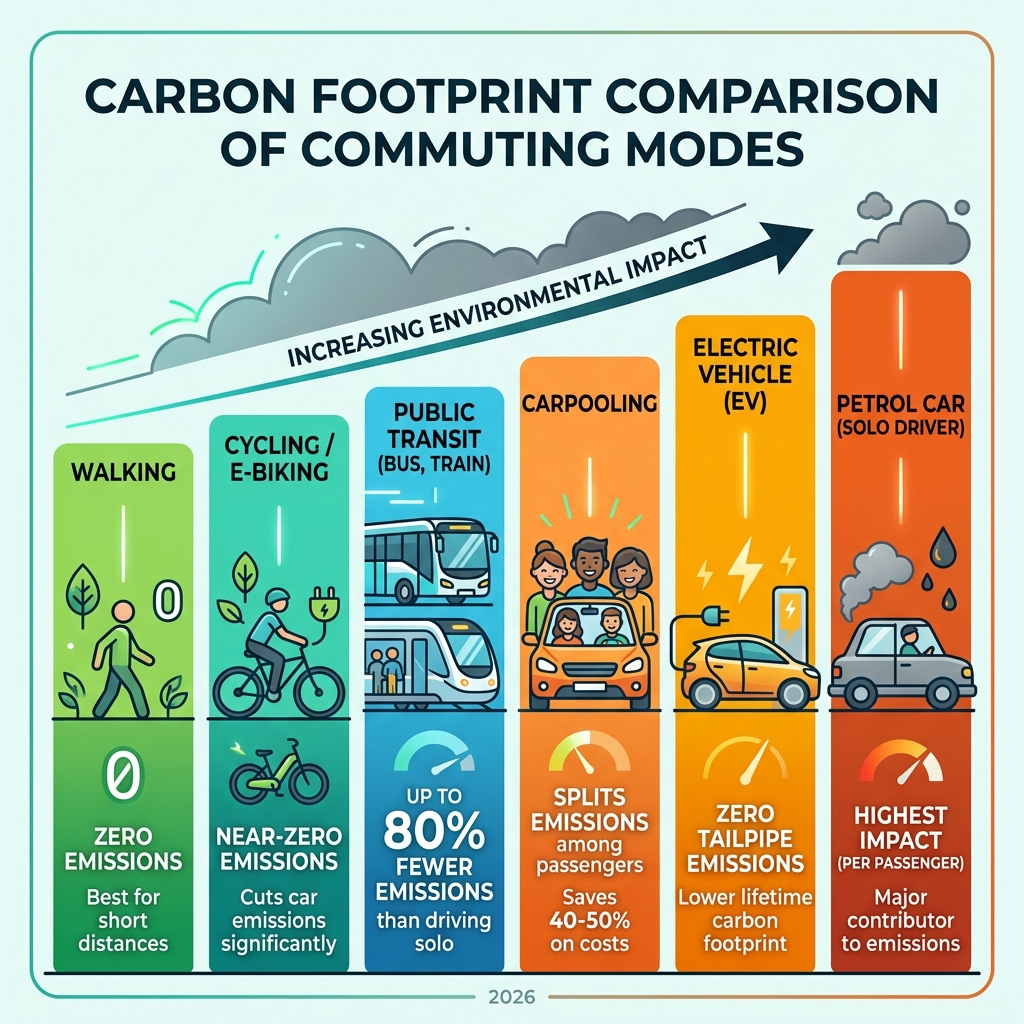
Sustainable commuting means choosing ways to get to work that produce fewer greenhouse gas emissions than driving alone in a petrol or diesel car. Here are the most common options, ranked from lowest to highest environmental impact:
- Walking – zero emissions, best for short distances
- Cycling or e-biking – near-zero emissions, cuts car emissions by up to 75%
- Public transit (bus, train, tram) – up to 80% fewer emissions than driving solo
- Carpooling or vanpooling – splits emissions across passengers, saves 40-50% on driving costs
- Electric vehicles (EVs) – zero tailpipe emissions, lower lifetime carbon footprint than petrol cars
- Telecommuting / remote work – eliminates the commute entirely
Here’s an uncomfortable truth: transportation is one of the biggest climate problems we face every single day. The transport sector is responsible for 13.7% of global greenhouse gas emissions. In the United States alone, it accounts for 27% of all emissions. In California, it’s even higher — a staggering 41%.
And yet, most of us don’t think twice about jumping in the car.
The good news? Your commute is one of the easiest places to make a real dent in your personal carbon footprint. You don’t need to overhaul your life. You just need to rethink one daily habit.
This guide breaks down the best sustainable commuting options available right now — with real numbers on what each one saves you in emissions, money, and time.
Why Sustainable Commuting is the Future of Transport
When we talk about the future, we often imagine flying cars or hyperloops. But the most radical change we can make right now is much more grounded. Shifting toward sustainable commuting isn’t just a trend; it’s a necessity for our planet and our pockets.
As we mentioned, transportation accounts for a massive chunk of our greenhouse gas (GHG) footprint. In the U.S., that 27% of total emissions comes largely from the millions of us driving solo to work every morning. This doesn’t just warm the planet; it chokes our cities with air pollution, leading to millions of premature deaths globally each year due to poor air quality.
By choosing Sustainable Transportation | Cool California, we address more than just carbon. We tackle energy efficiency and economic resilience. Did you know that fossil fuel subsidies reached a mind-blowing $7 trillion in 2022? By moving away from petrol-dependent travel, we reduce our reliance on volatile oil prices and help shift the economy toward renewable energy.
There are also massive Benefits of a Sustainable Commute for our communities. Fewer cars mean less traffic congestion, quieter streets, and more space for parks instead of parking lots. For the individual, it’s a win-win: you save money on fuel and maintenance while often getting a better workout or a less stressful start to your day.
Top Eco-Friendly Ways to Transform Your Daily Travel
Making the switch doesn’t have to happen overnight. Many of us find success by starting small—maybe one day a week—and gradually increasing our “green” days. The goal is to move toward a “systems approach” where we use different modes of transport depending on the weather, our schedule, and the distance.

When we look at Sustainable Transportation: Exploring Eco-Friendly Commuting Options, we see a hierarchy of efficiency. To help you visualize the impact, consider this:
| Commute Mode | CO2 Savings (vs. Solo Driving) | Primary Benefit |
|---|---|---|
| Walking/Biking | 100% (Tailpipe) | Health & Zero Cost |
| Train | ~80% | Productivity & Speed |
| Public Bus | ~33-50% | Reduced Congestion |
| Carpooling | ~50% (per person) | Cost Sharing |
| Electric Vehicle | ~50-70% (Lifecycle) | Modern Convenience |
Active Transport: Walking and Cycling
If your office is within a few miles, walking or cycling is the undisputed king of sustainable commuting. It produces zero greenhouse gas emissions and zero air pollutants. Research shows that using a bike instead of a car for short distances reduces your commute emissions by 75%.
But the benefits aren’t just environmental. We’ve found that people who walk or bike to work report higher levels of mental well-being. It’s a chance to engage in “walking meditation,” unplugging from the digital world before the workday begins. Physically, it’s a powerhouse move—adults in walkable neighborhoods have significantly better heart health and lower risks of obesity.
To get started, we recommend checking your local bike lanes and pedestrian infrastructure. Many cities are now investing in “Bike-to-Work” schemes and protected lanes to make active travel safer. You can find excellent tips on How to green your commute – David Suzuki Foundation, such as wearing layers and carrying a basic repair kit.
The Power of Public Transit
For those of us with medium-to-long commutes, public transit is the backbone of sustainability. In the U.S. alone, public transportation saves 37 million metric tons of carbon dioxide annually and 11 million gallons of gasoline every single day.
If you switch a 20-mile solo commute by car to a train or bus, you can reduce your annual CO2 emissions by a staggering 48,000 pounds. That is a life-changing amount of carbon kept out of the atmosphere.
Beyond the planet, transit offers “found time.” Instead of gripping a steering wheel in frustrating traffic, you can read a book, catch up on emails, or even nap. Many employers also offer pre-tax benefits or transit subsidies, making this one of the most cost-effective ways to travel.
Carpooling and Shared Mobility
We get it—sometimes the bus doesn’t go where you need it to, or the hills are too steep for a bike. This is where carpooling and shared mobility shine. By simply adding one other person to your car, you can cut your commute costs by 40-50% and reduce your yearly emissions by up to 18%.
Carpooling allows you to take advantage of HOV (High Occupancy Vehicle) lanes, which often move much faster during rush hour. Many organizations now offer an “Emergency Ride Home” program, which reimburses you for a taxi or Uber if you carpool to work but have a family emergency and need to leave early.
You can find more advice on How to Make Your Commute More Sustainable | Future.Green, including how to use “trip linking”—combining errands like grocery shopping or school drop-offs into one single journey with a warm engine to reduce “cold start” pollution.
Electric Vehicles and E-mobility
The world of transport is electrifying fast. Electric cars represented more than 20% of all cars sold in 2024, and that’s expected to hit 25% by 2025. EVs have zero tailpipe emissions and are much more energy-efficient than internal combustion engines.
However, the real “secret weapon” of e-mobility is the e-bike. E-bikes have the potential to take 8 million cars off the road. They emit 100 times fewer greenhouse gases than a standard car and allow you to tackle long distances and steep hills without arriving at work drenched in sweat.
As noted in Sustainable Transportation: Eco-Friendly Commuting Options, we must be mindful of the lifecycle of lithium-ion batteries. While EVs are much greener overall, we should support battery recycling and reuse programs to ensure the minerals used are handled responsibly.
Strategies for Hybrid Workers and Sustainable Organizations
The rise of hybrid work has changed the commute landscape. Interestingly, when everyone goes to the office on the same Tuesday and Wednesday, it can actually make traffic congestion worse on those days. This makes sustainable commuting even more critical for hybrid workers.
Organizations have a huge role to play here. We’ve seen that when employers get involved, the results are impressive. For example, MIT reduced on-campus parking by 15% in just three years simply by offering free public transportation passes to staff.
Here are some ways organizations can help:
- Transit Subsidies: Partnering with local authorities to provide discounted or free passes.
- Bike-to-Work Schemes: Providing secure bike storage, lockers, and even showers for active commuters.
- Flexible Schedules: Allowing “no-commute days” or shifting hours to avoid peak rush-hour traffic.
- TDM Week: Participating in Transportation Demand Management weeks to kickstart new habits.
If you’re looking for more inspiration, we have a whole list of green-commuting-ideas to help you and your coworkers get started. You can also find more 6 ways to encourage sustainable commuting | Bev that focus on building a culture of sustainability within the office.
Practical Tips for a Greener Daily Routine
Ready to take the plunge? Here is how we recommend planning your new, greener routine:
- Plan Your Route: Don’t just follow the GPS. Look for quiet streets or dedicated bike paths that might be a minute longer but much more pleasant.
- Invest in Gear: A good waterproof jacket and a sturdy pannier bag for your bike make a world of difference.
- Mind the “Cold Start”: Did you know a one-mile trip with a cold engine pollutes up to 70% as much as a ten-mile trip? If you must drive, try to link your errands together so the engine stays warm.
- Practice Eco-Driving: If you are driving a petrol car, avoid aggressive acceleration and braking. Speeding over 60 mph can drop your fuel economy by 7% for every 5 mph you go over the limit.
- Community Building: Join a local carpool group or a cycling coalition. Commuting is much more fun when you’re doing it with others!
For students or those heading to a large campus, check out specific resources like How can I have a more sustainable commute to campus? to find local shuttle schedules and e-bike rebate programs.
Frequently Asked Questions about Eco-Friendly Travel
How can I start sustainable commuting today?
The easiest way to start is to pick one day this week to leave the car at home. Use a journey planner app to see if there’s a bus or train route you haven’t considered. If you live close enough, try walking! You don’t need a fancy bike or an EV to begin; you just need a plan.
What are the most cost-effective sustainable commuting options?
Walking and traditional cycling are essentially free once you have the basic gear. Public transit is the next best thing, especially when you factor in the thousands of dollars saved annually on petrol, insurance, and parking (roughly $10,000 a year for the average commuter).
How do e-bikes compare to traditional cars in emissions?
It’s not even close! An e-bike produces about 100 times fewer greenhouse gas emissions than a car that gets 30 mpg. Even when you account for the electricity used to charge the battery, e-bikes are one of the most sustainable inventions of the last century.
Conclusion: Your Role in Sustainable Commuting
At the end of the day, sustainable commuting is about more than just carbon numbers—it’s about the kind of world we want to live in. Do we want cities defined by six-lane highways and smog, or cities defined by parks, quiet streets, and healthy people?
Every time you choose the bus, hop on your bike, or share a ride with a colleague, you are casting a vote for a cleaner future. At Refugio do Jardim, we believe that individual choices create a ripple effect. When your neighbors see you cycling or your coworkers see you using the train, it gives them the “social permission” to try it too.
Changing a lifelong habit is a major behavioral shift, but it’s one that pays off in health, happiness, and a healthier planet. We encourage you to start your journey with these green commuting ideas and see how much better your morning can be.
The planet is waiting—and so is a much better way to get to work. Let’s make the move together.
