
How to Shrink Your Footprint Without Losing Your Mind
Why Climate Change Feels Overwhelming — And What You Can Actually Do About It
Greenhouse gas emissions can be reduced by making changes across energy, transportation, food, and waste — at every scale, from your kitchen to your government.
Here’s a quick overview of the most impactful ways to cut emissions:
| Category | Key Action | Estimated Impact |
|---|---|---|
| Home energy | Switch to LEDs, add insulation, use heat pumps | Up to 75% energy savings on lighting |
| Transportation | Drive electric or use public transit | Transport = 14% of global emissions |
| Diet | Eat less meat, reduce food waste | Food waste alone = up to 8% of global GHGs |
| Clean energy | Switch to solar or renewable electricity | Electricity = 25% of global emissions |
| Policy support | Back carbon pricing and clean energy laws | $100/ton carbon price could cut 16–31 Gt CO2/yr |
Climate news hits hard. Wildfires. Floods. Record heat. It’s a lot to process — especially when you’re already juggling work, family, and a full schedule.
The good news? You don’t need to overhaul your entire life to make a real difference.
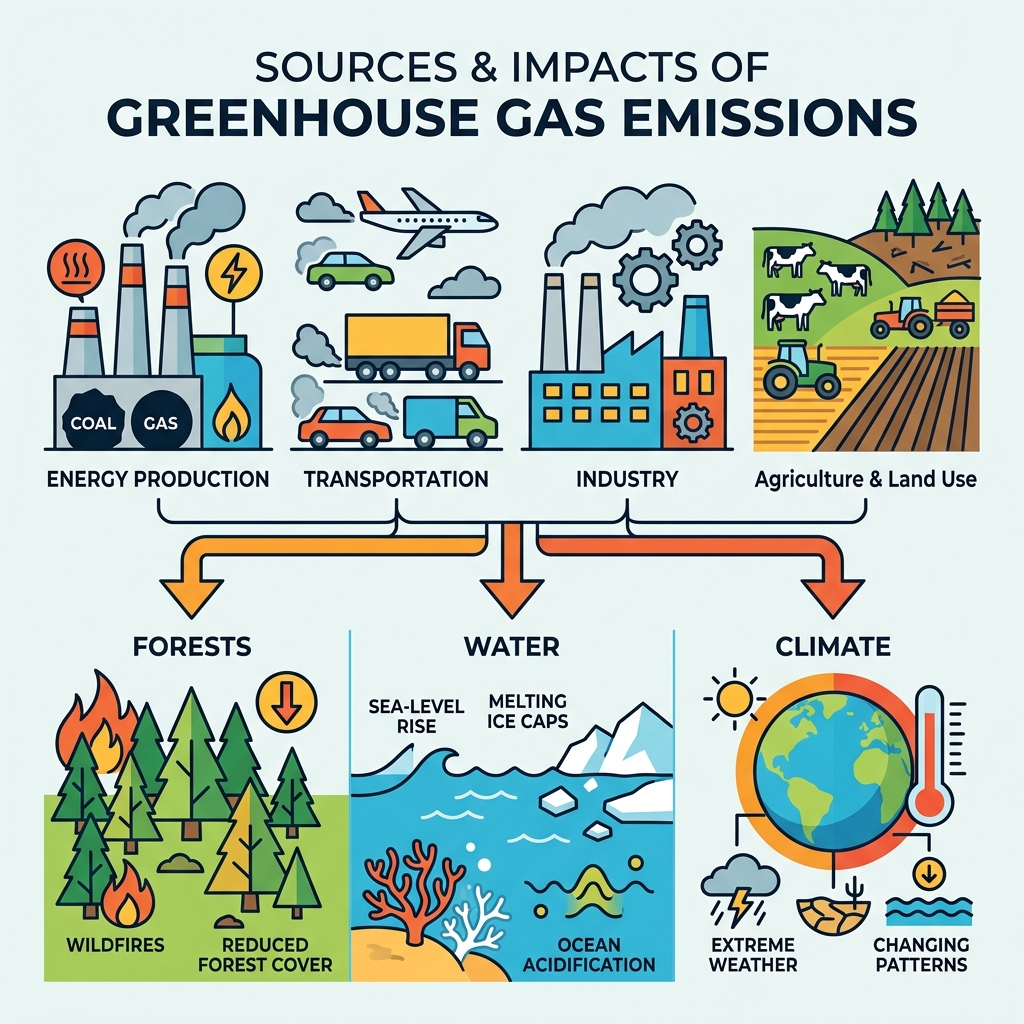
Global greenhouse gas emissions come from burning fossil fuels for electricity, transportation, and industry — plus agriculture and land use. The science is clear: every reduction counts, whether it comes from a household, a city, or a national policy.
The US already cut emissions by 12% between 2005 and 2019, mostly by shifting away from coal. The EU dropped theirs by 37% compared to 1990 levels by 2023. Progress is real. And the tools to go further already exist.
This guide breaks it all down into simple, doable steps — no guilt, no overwhelm.
Understanding the Sources: Where Do Emissions Come From?
Before we dive into the “how,” we need to understand the “where.” Greenhouse gases (GHGs) act like a thermal blanket for the Earth. When we burn fossil fuels or clear forests, we thicken that blanket, trapping more heat. To thin it out, we have to look at the heavy hitters.
Global vs. US Emission Sources
While the world shares the same atmosphere, the sources of pollution vary slightly by region. In the US, transportation has recently overtaken electricity as the top polluter. Globally, energy production for heat and light still wears the crown.
| Sector | Global Share | US Share (Approx.) |
|---|---|---|
| Electricity & Heat | 25% | 25% |
| Transportation | 14% | 29% |
| Industry | 21% | 23% |
| Agriculture/Land Use | 24% | 10% |
| Buildings | 6% | 13% |
According to scientific research on US mitigation strategies, US greenhouse gas emissions decreased by 12% between 2005 and 2019. This wasn’t magic; it was mostly due to replacing coal-fired electricity with natural gas and renewables like wind and solar.
The international community is aiming for “Net-Zero” by 2050. This means we aren’t just cutting emissions; we are balancing any remaining emissions by pulling carbon back out of the sky. To get there, the US needs to cut emissions by about 50–52% below 2005 levels by 2030. It’s a steep climb, but as the EU’s 37% drop proves, structural changes in the economy and a transition to clean energy make it possible.
Greenhouse gas emissions can be reduced by transforming your home
Our homes are our sanctuaries, but they are also mini power plants. From the water heater in the basement to the lightbulbs in the hallway, greenhouse gas emissions can be reduced by making our living spaces more efficient.

The Low-Hanging Fruit: Energy Efficiency
You don’t need a massive renovation to start saving. Efficiency is the “first fuel”—it’s the energy you never have to buy or burn in the first place.
- LED Lighting: Switching to LED bulbs is one of the easiest wins. LEDs use at least 75% less energy than incandescent bulbs and last 25 times longer.
- Smart Thermostats: These gadgets learn your habits and lower the heat or AC when you’re not home. Even a manual adjustment—setting the thermostat a few degrees lower in winter and higher in summer—makes a dent.
- Insulation and Sealing: Many homes “leak” air through attics and windows. Adding insulation and weather-stripping acts like putting a warm coat on your house, keeping the climate-controlled air inside where it belongs.
- Energy Star Appliances: When it’s time to replace an old fridge or dishwasher, look for the Energy Star label. These products are certified to use significantly less electricity and water.
Upgrading the Infrastructure
For those ready for a bigger step, there are more ways to reduce greenhouse gas emissions through home systems.
- Heat Pumps: Instead of burning gas or oil, heat pumps move heat from the outside air (even in winter!) into your home. They are incredibly efficient for both heating and cooling.
- Tankless Water Heaters: Traditional tanks keep 40-50 gallons of water hot all day, even when you’re sleeping. Tankless versions heat water on demand, saving energy and space.
- Home Energy Audits: Not sure where to start? A professional energy audit can pinpoint exactly where your home is losing energy. Many local utility programs even offer these for free or at a discount.
Powering with Renewables
If your roof gets good sun, solar panels can turn your home into a clean energy producer. If solar isn’t an option for your roof, many regions allow you to choose a “green power” provider through your utility, ensuring your electricity comes from wind or solar farms rather than coal plants.
Greening Your Plate and Your Commute
Outside the home, our two biggest points of impact are how we move and what we eat. These are daily choices that, when multiplied by millions of people, shift the entire global trajectory.
Greenhouse gas emissions can be reduced by smarter transportation
In places like Washington state, vehicle emissions account for over 39% of total GHGs—the single largest contributor. Globally, transportation adds up to 14% of emissions.
- Electric Vehicles (EVs): The goal is for 82% of light-duty vehicle sales to be electric by 2035. With battery costs dropping from $1000/kWh in 2010 to under $200 in 2022, EVs are becoming more accessible. They produce zero tailpipe emissions and become even cleaner as our power grid shifts to renewables.
- The Power of “Active” Transport: Biking and walking aren’t just good for your heart; they have a zero-carbon footprint.
- Public Transit and Carpooling: Taking the bus or train reduces the number of cars on the road. Even carpooling with a neighbor for work or school runs can cut your commute emissions in half.
- SmartWay and Logistics: For businesses, programs like the EPA’s SmartWay help freight shippers and carriers improve fuel efficiency, ensuring the products we buy don’t come with a massive carbon “delivery fee.”
Greenhouse gas emissions can be reduced by dietary shifts
It might surprise you to learn that what’s on your fork matters as much as what’s in your garage. Agriculture accounts for about 10% of US emissions and nearly a quarter globally.
- Plant-Rich Diets: Raising farm animals for meat—especially cattle—is resource-intensive. Cows release methane (a potent GHG) during digestion. If half the global population adopted a plant-rich diet by 2050, we could keep 65 gigatons of CO2 out of the atmosphere. You don’t have to go full vegan; even “Meatless Mondays” help.
- Reducing Food Waste: One-third of the world’s food is never eaten. This waste accounts for up to 8% of global emissions. When food rots in a landfill, it produces methane. By buying only what we need and composting scraps, we turn waste into nutrient-rich soil instead of greenhouse gas.
- Regenerative Agriculture: Supporting farmers who use cover crops and no-till farming helps “sink” carbon into the soil. Programs like AgSTAR also help farmers capture methane from livestock manure and turn it into biogas energy.
Scaling Up: Policy, Industry, and Nature-Based Solutions
While individual actions are vital, we also need big-picture changes. Greenhouse gas emissions can be reduced by large-scale policies and technological innovations that tackle the “hard-to-decarbonize” sectors like heavy industry and aviation.
Nature’s Own Technology: Carbon Sinks
The Earth has its own way of scrubbing the air: photosynthesis. Forests, wetlands, and healthy soils are “carbon sinks.”
- Reforestation: Planting trees is one of our best defenses. Reforestation in the US alone could sequester 200–500 million metric tons of CO2 per year.
- Protecting Wetlands: Rewetting drained wetlands and protecting salt marshes prevents stored carbon from escaping and allows these ecosystems to continue absorbing CO2.
Innovation and Industry
Manufacturing and industry produce about 20% of global emissions. We are seeing a shift toward:
- Industrial Electrification: Swapping fossil-fuel-powered furnaces for electric ones.
- Low-Carbon Materials: Developing “green cement” and bioplastics that don’t rely on fossil fuels.
- Hydrogen Fuel: Using “green hydrogen” (made with renewable electricity) to power heavy ships and planes that can’t easily run on batteries.
Policy and Economics
Governments play a massive role through GHG reduction programs and strategies. The Inflation Reduction Act (IRA) in the US is a landmark example, providing billions in incentives for clean energy and EVs.
- Carbon Pricing: By putting a price on carbon (around $100 per ton), we can incentivize companies to pollute less. This could reduce global emissions by 16 to 31 GtCO2-eq per year.
- Health and Equity: Reducing emissions isn’t just about the planet; it’s about people. Transitioning to clean energy could avoid up to 2 million deaths globally by 2050 by reducing air pollution. It also offers a chance to redress “legacies of inequity” by cleaning up the air in communities historically located near power plants and highways.
Frequently Asked Questions about Reducing Emissions
What are the primary sources of greenhouse gas emissions globally?
The big five are:
- Electricity and Heat Production (25%): Burning coal, oil, and gas.
- Industry (21%): Manufacturing chemicals, cement, and steel.
- Agriculture and Land Use (24%): Livestock, crops, and deforestation.
- Transportation (14%): Cars, trucks, planes, and ships.
- Buildings (6%): On-site energy use and burning fuels for cooking or heat.
How can individuals make the biggest impact on their carbon footprint?
The “Big Four” for individuals are:
- Eat more plants: Reducing meat consumption (especially beef) significantly lowers methane emissions.
- Travel wisely: Walk, bike, or use public transit. If you must drive, switch to an EV.
- Home Efficiency: Insulate your home and switch to LED lighting.
- Waste less: Reduce food waste and compost what you can.
What are the economic benefits of reducing greenhouse gas emissions?
Mitigation isn’t just a cost; it’s an investment. Benefits include:
- Lower Utility Bills: Efficiency and solar can slash monthly expenses.
- Job Creation: The clean energy sector is growing faster than the fossil fuel sector.
- Public Health Savings: Fewer respiratory illnesses mean lower healthcare costs.
- Avoided Disaster Costs: Spending money now to prevent floods and wildfires is much cheaper than cleaning up after them.
Conclusion
The journey to a sustainable future isn’t about perfection; it’s about direction. Greenhouse gas emissions can be reduced by a combination of the lightbulbs we choose, the food we eat, and the policies we support.
At Refugio do Jardim, we believe in the power of individual empowerment and collective action. By involving your family in a plan to reduce electricity use or starting a compost bin in the backyard, you are becoming an environmental steward.
The data shows we are making progress—emissions are falling in many parts of the world, and the technology to reach net-zero is already in our hands. Every ton of carbon we keep out of the atmosphere helps protect our water supplies, our forests, and our future. Let’s keep moving forward, one step at a time.
