
Make Your House a Green Home with These Tips
Your Home Has More Climate Power Than You Think
Reducing greenhouse gas emissions at home is one of the most direct ways you can fight climate change — and it doesn’t require a complete lifestyle overhaul.
Here are the most impactful steps you can take right now:
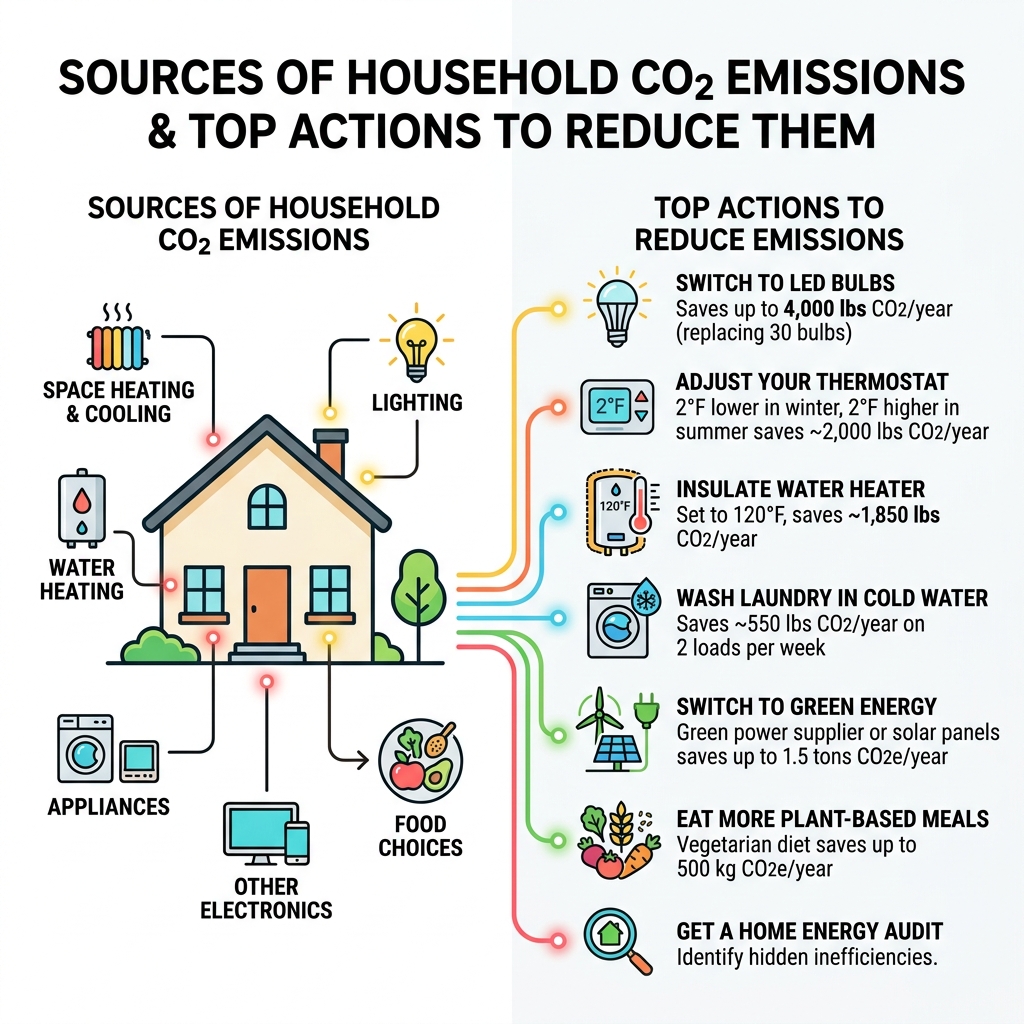
- Switch to LED bulbs — saves up to 4,000 lbs of CO2 per year (replacing 30 bulbs)
- Adjust your thermostat — 2°F lower in winter, 2°F higher in summer saves ~2,000 lbs CO2/year
- Insulate your water heater and set it to 120°F — saves ~1,850 lbs CO2/year
- Wash laundry in cold water — saves ~550 lbs CO2/year on two loads per week
- Unplug electronics and use power strips to eliminate ghost power
- Switch to a green energy supplier or install solar panels — saves up to 1.5 tons CO2e/year
- Eat more plant-based meals — a vegetarian diet saves up to 500 kg CO2e/year
- Get a home energy audit to find hidden inefficiencies
Your home is responsible for a surprisingly large slice of your personal carbon footprint. Heating, cooling, lighting, appliances, the food in your fridge — they all add up.
The good news? Small, targeted changes deliver real, measurable results. You don’t need to go off-grid or spend a fortune. Many of the most effective actions cost little to nothing and can start today.
This guide walks you through every room and habit — with the numbers to back it up.
The Importance of Reducing Greenhouse Gas Emissions at Home
When we talk about climate change, it is easy to feel like the problem is too big for one household to handle. We often look at massive power plants or industrial factories as the primary culprits. While they certainly play a huge role, our residential choices are a massive piece of the puzzle. In fact, more than half of the electricity in the United States comes from power plants fueled by coal and natural gas, making them the single largest source of heat-trapping gases.
By focusing on reducing greenhouse gas emissions at home, we aren’t just helping the planet; we are also helping our wallets. Many of the actions that protect our natural resources also lead to significant cost savings on utility bills. We can think of it as a “green-green” situation: green for the Earth and green for your bank account.
What is a Carbon Footprint?
A carbon footprint is the total amount of greenhouse gases—including carbon dioxide (CO2), methane (CH4), and nitrous oxide (N2O)—that are emitted into the atmosphere because of our specific products, activities, and behaviors. Every time we drive a gas-powered car, turn on a heater fueled by oil, or even throw away food that ends up rotting in a landfill, we are adding to that footprint.
While the average global carbon footprint is about 6.6 tons per person, people in high-income countries often have a footprint three times that size. To limit global warming to 2°C, experts suggest we should aim for a personal allowance of about 1.87 tons per year by 2050. You can get a baseline of where you stand by using the Household Carbon Footprint Calculator | US EPA. Understanding your starting point is the first step in reducing carbon footprint at home.
Why Home Action Matters
Why should we care about what happens within our four walls? Because residential energy use is a major contributor to national emissions. When we use less electricity, power plants don’t have to burn as much fossil fuel. This collective impact is massive. For example, if every household in the U.S. replaced just one regular light bulb with an energy-saving model, we could reduce global warming pollution by more than 90 billion pounds—the equivalent of taking 6.3 million cars off the road!
As noted by the How You Can Help Reduce Greenhouse Gas Emissions at Home – NPS, simple measures like sealing ducts or installing a programmable thermostat can reduce a typical family’s CO2 emissions by about 5%. We have the power to influence the market and the environment simply by changing how we manage our households.

Energy Efficiency: Lighting, Appliances, and Smart Tech
One of the easiest places to start reducing greenhouse gas emissions at home is with the technology we use every day. We live in an era where “smart” doesn’t just mean connected to the internet; it means being intelligent about energy consumption.
Smart Habits for Reducing Greenhouse Gas Emissions at Home
Habits are just as important as hardware. One of the biggest “silent” energy drains in the modern home is “ghost power” or “phantom load.” This refers to the energy consumed by electronics even when they are turned off. Many devices, like TVs, computers, and chargers, continue to draw power as long as they are plugged in.
To combat this, we recommend using power strips to group electronics together. With one flip of a switch, you can completely cut the power to your entire entertainment center or home office. It’s a simple way to practice energy-saving habits for families. Additionally, turning off your computer when you are away for more than 10 minutes is a great habit—contrary to the old myth, modern computers are not harmed by being turned on and off frequently.
Upgrading to Energy Star Appliances
When it is time to replace an old refrigerator, dishwasher, or clothes washer, always look for the Energy Star label. These products meet strict energy-efficiency guidelines set by the EPA and the Department of Energy.
- Refrigerators: If everyone used high-efficiency refrigerators, the U.S. would need 30 fewer power plants.
- Lighting: LED lamps use about 85 percent less energy than incandescent bulbs and last up to 25 times longer. Replacing 30 bulbs with LEDs can reduce your CO2 output by 4,000 pounds per year!
- Savings: Over their lifetime, Energy Star products can save a household roughly $11,000 on energy bills while preventing 130,000 pounds of greenhouse gas emissions.
For more detailed advice on lighting, check out our guide on eco lighting: brightening your home sustainably. You can also find broader tips in our article on harnessing energy efficiency: essential tips for eco-friendly homes and the power of conservation: essential energy-saving tips for every home.
| Feature | Incandescent Bulbs | LED Bulbs |
|---|---|---|
| Energy Use | 100% (Baseline) | ~15-25% |
| Lifespan | ~1,000 hours | Up to 25,000+ hours |
| Heat Emission | High (90% is heat) | Very Low |
| Annual CO2 (30 bulbs) | High | 4,000 lbs less |
Optimizing Heating, Cooling, and Water Usage
Heating and cooling account for nearly half of the average home’s energy use. This makes the HVAC system the “heavy lifter” of your carbon footprint. By making this system more efficient, we can make huge strides in reducing greenhouse gas emissions at home.
Advanced Upgrades for Reducing Greenhouse Gas Emissions at Home
If you are looking for long-term impact, consider these structural and mechanical upgrades:
- Heat Pumps: Replacing an oil or gas furnace with an electric heat pump can reduce your carbon footprint by up to 900 kilograms (nearly 2,000 lbs) of CO2e per year.
- Duct Sealing: Leaky ducts can reduce the efficiency of your heating and cooling system by 20% or more. Sealing and insulating ducts ensures the air you pay to heat or cool actually reaches your living spaces.
- Tankless Water Heaters: While they may cost more upfront (about $800 more on average), they can save significant energy by only heating water as you need it, rather than keeping a giant tank hot 24/7.
- Windows: Replacing single-paned windows with dual-paned, high-efficiency versions keeps your home’s temperature stable and reduces the load on your HVAC system.
For a deeper dive into these topics, see our articles on home insulation: enhancing energy efficiency and saving the earth: innovative ways to reduce energy consumption at home.
Managing Your Thermostat for Maximum Impact
You don’t always need new equipment to see results. The “2-degree rule” is a powerful tool: setting your thermostat just 2°F lower in the winter and 2°F higher in the summer can reduce CO2 emissions by 2,000 pounds per year.
A programmable thermostat is a must-have for easy energy reduction: eco-friendly tips for your household. It allows you to automatically adjust the temperature when you are sleeping or away from home, which can save a typical family about $100 a year on energy bills. Don’t forget basic maintenance, either—changing your air filters regularly ensures your system doesn’t have to work overtime just to breathe.
Sustainable Habits in the Kitchen and Laundry Room
The kitchen and laundry room are high-traffic areas where small habit shifts can lead to big environmental wins.
Laundry and Dishwashing Habits
Did you know that about 90% of the energy used by a washing machine goes toward heating the water? By switching to cold or warm water for just two loads a week, you can reduce your CO2 emissions by 550 pounds per year.
- Full Loads Only: Always wait until you have a full load before running the dishwasher or the washing machine. Running a full dishwasher instead of hand-washing can save 100 pounds of CO2 and $40 per year.
- Line Drying: Whenever the weather permits, skip the dryer and hang your clothes on a line. It’s free, smells great, and eliminates the emissions from one of the home’s biggest energy hogs.
Check out more tips in easy energy reduction: eco-friendly tips for your household 2.
Reducing Food Waste and Composting
Food waste is a significant climate issue. Approximately one-third of the world’s food is never eaten. When food scraps end up in a landfill, they rot without oxygen and produce methane—a greenhouse gas that is 25 times more potent than CO2.
By composting your food scraps and yard waste, you keep that material out of the landfill and create nutrient-rich soil for your garden. Food and yard waste make up 20-30% of what we throw away, so composting is a major step in energy-saving habits for families 2.
Eating Lower on the Food Chain
What we put on our plates matters just as much as how we cook it. Livestock production is responsible for about 14.5% of global manmade greenhouse gas emissions.
- Plant-Rich Diet: Shifting from a meat-heavy diet to a vegetarian diet can reduce your carbon footprint by 500 kilograms of CO2e per year. A vegan diet can save up to 900 kilograms.
- Meatless Mondays: You don’t have to go fully vegan to help. Skipping meat and dairy just one day a week saves about 8 pounds of CO2 per day, or nearly 3,000 pounds a year!
- Shop Local: Buying food from local farmers’ markets reduces the “food miles” associated with transportation, further reducing greenhouse gas emissions at home.
Renewable Energy and Long-Term Home Upgrades
Once you have maximized your home’s efficiency, the next step is to look at the source of your energy.
Switching to Green Power Options
You don’t necessarily need to install solar panels on your roof to use renewable energy. Many utility companies now offer “green power” options, allowing you to pay a small premium to ensure your electricity comes from wind, solar, or hydro sources.
- Green Tags and Offsets: If your utility doesn’t offer green power, you can purchase “green tags” or carbon offsets. These fund renewable energy projects elsewhere to balance out your own emissions.
- Solar Lights: For outdoor areas, solar-powered lights are a fantastic way to illuminate your yard or walkways without using any grid electricity.
Getting the Family Involved and Tracking Progress
Sustainability is a team sport. We recommend developing a family plan where everyone takes responsibility for one action—like being the “light monitor” who ensures all switches are off before leaving the house.
To keep the momentum going:
- Conduct a Home Energy Audit: Many local utilities offer free professional audits to find air leaks and insulation gaps.
- Track Your Progress: Use the EPA calculator mentioned earlier to see how your footprint shrinks as you implement these changes.
- Look for Incentives: Check for local rebates on Energy Star appliances, heat pumps, or solar installations. These can often shave thousands of dollars off the cost of upgrades.
Frequently Asked Questions about Home Emissions
How much CO2 can I save by switching to LEDs?
Replacing 30 incandescent bulbs with LED lamps can reduce your CO2 emissions by approximately 4,000 pounds per year. LEDs use about 85% less energy and last up to 25 times longer than traditional bulbs.
Does unplugging “ghost power” devices really help?
Yes! Electronics and appliances plugged into the wall continue to draw power even when turned off. Using power strips to completely disconnect these devices can reduce your home’s total electricity use significantly over the course of a year.
What is the most effective way to reduce heating emissions?
The most effective way is a combination of behavior and technology: set your thermostat 2°F lower in the winter, ensure your home is well-insulated and sealed, and consider upgrading to an electric heat pump, which can cut emissions by up to 900 kg of CO2e per year.
Conclusion
At Refugio do Jardim, we believe that environmental stewardship starts at the front door. Reducing greenhouse gas emissions at home isn’t about sacrifice; it’s about smarter living. By choosing energy-efficient lighting, being mindful of our water use, and making conscious choices about the food we eat, we contribute to a healthier planet and a more sustainable future for our communities.
Every small action—from washing a load of laundry in cold water to composting your morning coffee grounds—adds up to a massive collective impact. Start with one or two changes today, and watch how easy it is to make your house a truly green home.
Are you ready to take the next step? Start your green home journey today and explore more ways to live in harmony with nature.
