
The Best LED Barn Lights for Your Farmhouse
The Smartest Way to Light Your Farmhouse
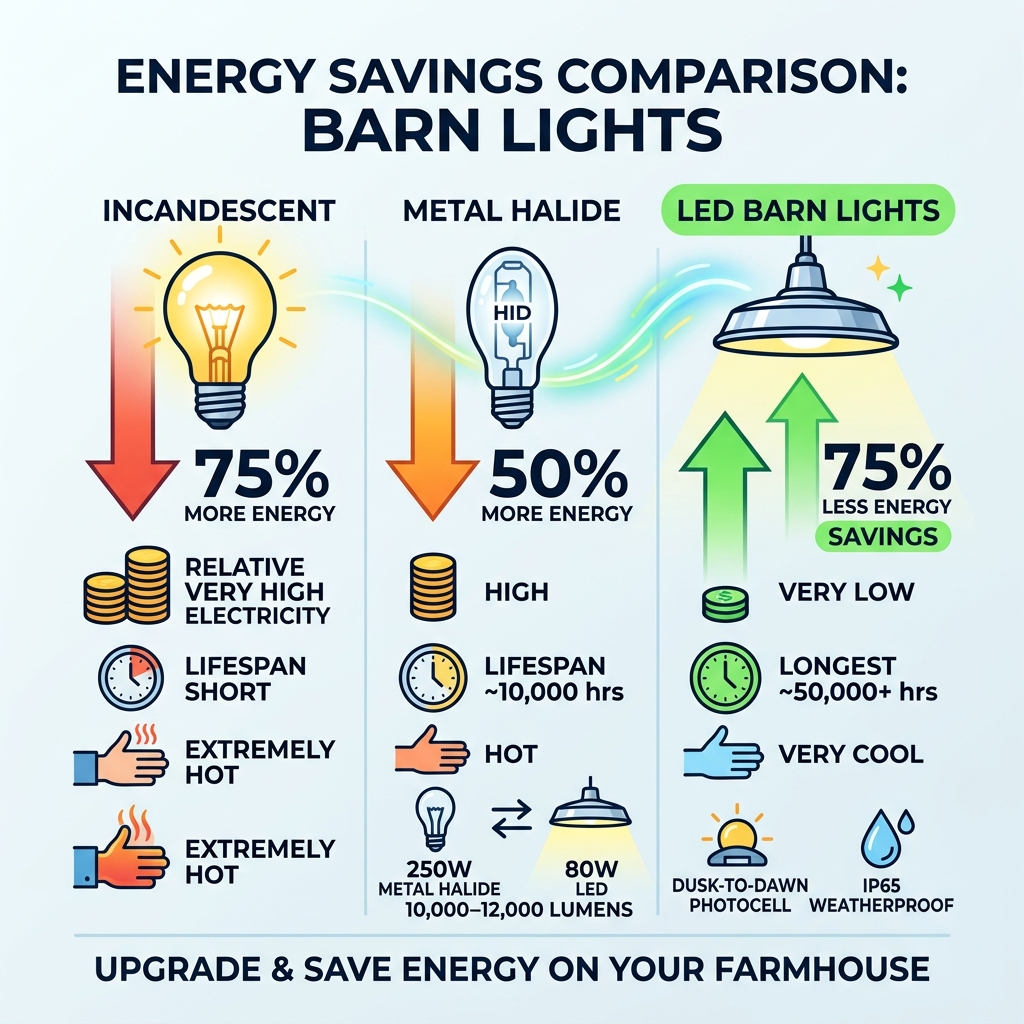
Energy saving barn lights are one of the best upgrades you can make for your farmhouse’s outdoor and barn lighting – cutting energy use by up to 75% compared to traditional bulbs.
Quick answer – the top reasons to switch:
- 75% less energy than incandescent and halogen bulbs
- 50,000+ hour lifespan vs. roughly 10,000 hours for metal halide
- 80W LED replaces a 250W metal halide fixture, delivering 10,000-12,000 lumens
- Automatic dusk-to-dawn operation via built-in photocell sensors
- IP65-rated weatherproofing handles rain, snow, and extreme temperatures
- Lower fire risk due to significantly reduced heat output
If you run a farmhouse, small farm, or rural property, lighting is one of your biggest hidden energy costs. Traditional metal halide and incandescent barn lights burn through electricity – and they burn out fast.
The good news? Switching doesn’t have to be complicated. Modern LED barn lights are designed to drop right in where your old fixtures were, with zero fuss.
This guide rounds up the best options and features to look for, so you can make a confident choice without spending hours researching.
Why You Should Upgrade to Energy Saving Barn Lights
When we talk about the “good old days,” we usually aren’t talking about the electric bill. Traditional lighting like metal halide (MH), high-pressure sodium (HPS), and incandescent bulbs have served us for decades, but they are notorious energy hogs. If you’ve ever touched a metal halide fixture after it’s been on for an hour, you know it feels more like a space heater than a light source. That heat is literally wasted money.
The Numbers Don’t Lie: LED vs. Traditional
To understand why energy saving barn lights are a game-changer, we have to look at the efficiency gap. Traditional bulbs convert a huge portion of energy into heat rather than light. In contrast, LEDs are designed for high efficacy-measured in Lumens Per Watt (LPW). According to the U.S. Department of Energy, LED lighting uses at least 75% less energy than incandescent lighting and lasts up to 25 times longer.
| Feature | LED Barn Light | Metal Halide (MH) | Incandescent |
|---|---|---|---|
| Energy Reduction | Up to 75% | Baseline | Very Low Efficiency |
| Lifespan | 50,000 – 100,000 Hours | 10,000 – 15,000 Hours | 1,000 Hours |
| Maintenance | Almost Zero | Frequent Bulb/Ballast Changes | Constant Replacement |
| Heat Output | Very Low | Extremely High | High |
| Startup | Instant On | 5-10 Minute Warm-up | Instant On |
As we explore in our guide on eco-lighting-brightening-your-home-sustainably, making the switch is one of the most effective ways to reduce your household’s environmental footprint while keeping your wallet heavy.
ROI and Cost-Effectiveness
Let’s talk turkey: the Return on Investment (ROI). A common setup for a farmyard is an 80W LED fixture. This compact powerhouse can easily replace a 250W metal halide lamp. Not only are you using less than a third of the power, but you are also getting a more stable, brighter light.
With an efficacy of 130 to 160 LPW, these lights deliver between 10,400 and 12,000 lumens. When you factor in the 50,000-hour lifespan (which is about 11 years if left on for 12 hours every single night), you save hundreds of dollars in electricity and replacement bulbs over the life of the fixture.
Safety First: Fire Risk and Heat
In a barn environment, safety is paramount. Barns often contain hay, dry wood, and dust-all of which are highly flammable. Traditional HID (High-Intensity Discharge) lamps operate at incredibly high temperatures. If a bulb breaks or a ballast malfunctions, it can become a fire hazard. LED barn lights generate very little heat, significantly reducing the risk of accidental combustion. They are also built with solid-state technology, meaning there’s no glass to shatter or mercury to leak, making them a much safer choice for animal stalls and hay lofts.
Choosing the Right Energy Saving Barn Lights for Your Space
Selecting the right light isn’t just about picking the highest wattage. In LED, we focus on lumens (the amount of light produced) rather than watts (the energy consumed).
Understanding Lumens and Area Size
How much light do you actually need?
- Small Sheds or Porches: Look for fixtures around 1,500 to 4,000 lumens. A low-bay LED barn light is often perfect for these low-ceiling or smaller interior spaces.
- General Yard Security: An 80W to 90W model is the industry standard, typically providing enough coverage for a large driveway or the side of a barn.
- Large Arenas or Commercial Lots: You may want to go up to 120W or 150W, delivering over 15,000 lumens, especially if you need broad, consistent coverage.
Color Temperature (CCT)
Color temperature is measured in Kelvin (K).
- 3000K (Warm White): Best for a classic, cozy farmhouse aesthetic or interior living spaces.
- 4000K (Cool White): Great for workshops and garages where you need clear visibility without it feeling too “clinical.”
- 5000K (Daylight): The gold standard for outdoor security. It mimics the midday sun and provides the best contrast for security cameras.
Many modern fixtures now come with selectable CCT, allowing you to toggle between these settings during installation.
Light Distribution
Think about where the light needs to go. Most barn lights use a “Type V” distribution, which is a circular pattern that spreads light evenly in all directions. This is ideal for mounting on a pole in the middle of a yard. If you are mounting on a wall, look for fixtures with built-in shields or specific optics that push the light forward and down to avoid wasting energy by lighting up the side of your building.
How to Install Energy Saving Barn Lights for Maximum Performance
Even the best light won’t perform if it’s installed poorly. To get the most out of your energy saving barn lights, follow these professional tips.
Optimal Mounting Height
For general yard lighting, we recommend a mounting height of 20 to 25 feet. This height allows the light to spread wide enough to cover a large radius while still being bright enough at ground level for safety. If you mount it too low, you create “hot spots” (areas that are blindingly bright) and deep shadows elsewhere.
Photocell Positioning
Most modern barn lights come with a “dusk-to-dawn” photocell. This sensor tells the light to turn on when it gets dark and off when the sun rises. When installing, ensure the photocell isn’t blocked by an eave or pointed toward another light source (like a neighbor’s porch light), which could cause the light to flicker on and off.
Wiring and Dimming
Most commercial-grade LED barn lights are hard-wired and compatible with 120-277V systems. If you want even more control, look for fixtures with 0-10V dimming. This allows you to reduce the light output during late-night hours when full brightness isn’t needed, further reducing-carbon-footprint-at-home.
For those looking for more general tips on lowering bills, check out our article on saving-the-earth-innovative-ways-to-reduce-energy-consumption-at-home.
Top Types of LED Barn Lights for Every Application
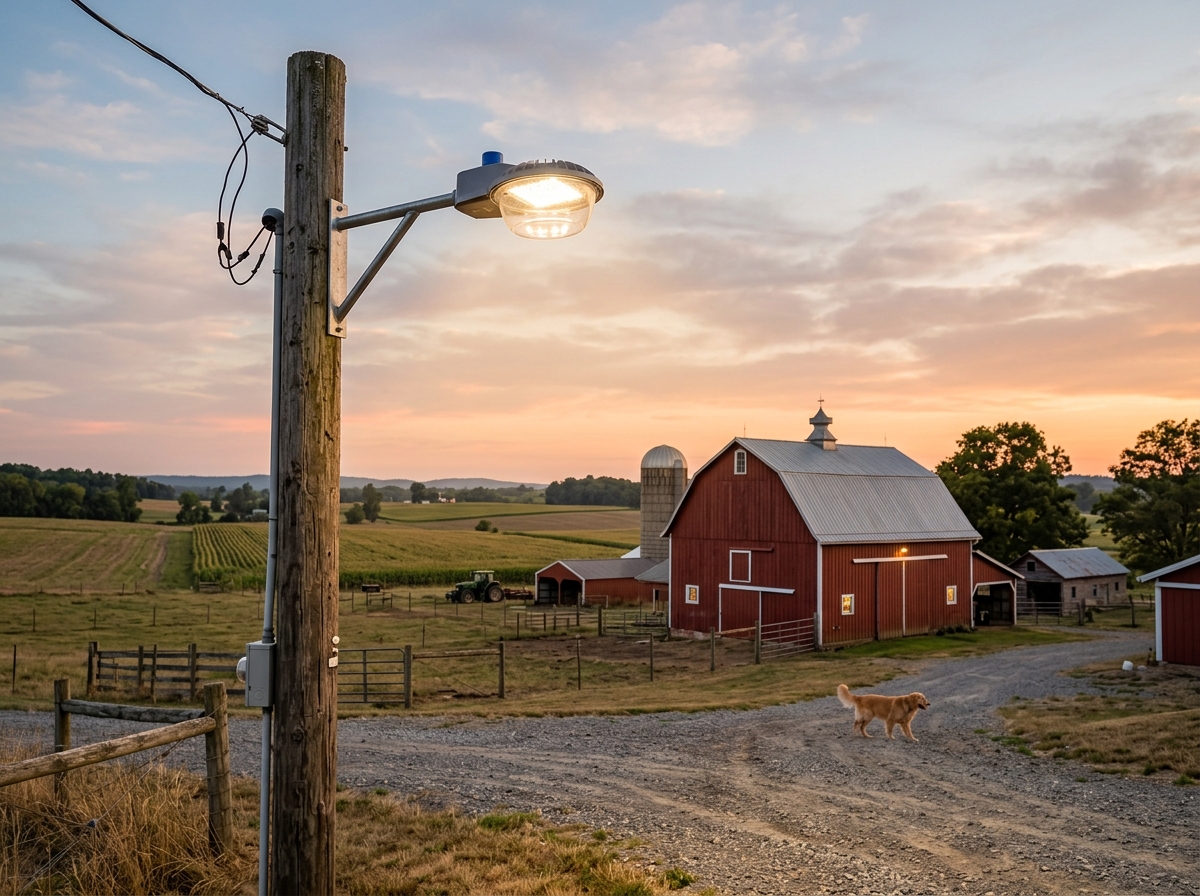
Not all barns are the same, and neither are the lights designed for them. Here are the most common styles we see on modern farmsteads:
1. Wall-Mounted Barn Lights (Area Lights)
These are the classic gooseneck or arm-mounted lights you see above barn doors. They are excellent for perimeter security and can mount easily to standard junction boxes.
2. Pole-Mounted Lights
If you need to illuminate a central driveway or a riding arena, pole mounting is the way to go. Many barn lights come with a versatile mounting bracket that can fit a standard 2-3/8 inch O.D. tenon or be bolted directly to a wooden utility pole.
3. Canopy and UFO Lights
For high-ceiling interiors like machine sheds, workshops, or indoor arenas, UFO-style canopy lights are king. They provide powerful downward light and are usually dust-resistant-a must-have for woodworking shops or hay storage.
4. Low Bay Decorative Barn Lights
Who says energy efficiency can’t be pretty? Decorative LED barn lights provide that vintage look with modern internals. These are perfect for kitchen islands, hallways, or laundry rooms, blending style with the sustainability principles found in eco-lighting-brightening-your-home-sustainably-2.
Key Features for Durability and Efficiency
When you’re shopping for energy saving barn lights, you want to ensure the fixture can survive the real world. Here are the technical specs that actually matter:
Weatherproofing: IP Ratings
Don’t just take the box’s word for it that a light is “outdoor rated.” Look for the IP (Ingress Protection) rating:
- IP65: Dust-tight and protected against water jets. This is the standard for most quality barn lights.
- IP66: Protected against powerful water jets. Ideal for coastal areas or places with heavy wind-driven rain.
A sealed gasket is vital for keeping out moisture, but also for keeping out insects. There’s nothing more annoying (or energy-wasting) than a light fixture filled with dead moths.
Build Quality and Heat Dissipation
Look for die-cast aluminum housing. Aluminum is excellent at pulling heat away from the LED chips (acting as a heat sink), which is the secret to reaching that 50,000-hour lifespan. Cheap plastic housings can trap heat and lead to early failure. Pair this with a UV-resistant polycarbonate lens to ensure the light doesn’t turn yellow and brittle after a few years in the sun.
Certifications to Look For
- UL/ETL: Ensures the light has been tested for safety.
- DLC (DesignLights Consortium): This is a big one. DLC-certified lights meet strict efficiency and quality standards. Often, utility companies require a DLC rating to qualify for energy-efficiency rebates.
- RoHS: Ensures the product is free from hazardous materials like lead or mercury.
For more on how these choices impact your home’s overall efficiency, see our tips on harnessing-energy-efficiency-essential-tips-for-eco-friendly-homes.
Selectable Features
The latest trend in energy saving barn lights is field-adjustable settings. A single fixture might allow you to choose between 32W, 48W, 64W, or 80W. This is incredibly helpful because you don’t always know exactly how much light you need until the fixture is actually mounted. If you already know your target brightness, a fixed-wattage model can also be a reliable replacement option.
Frequently Asked Questions about Energy Saving Barn Lights
Are LED barn lights safe for use around livestock?
Yes, absolutely! In fact, they are often safer than traditional options. Because they produce very little heat, they don’t significantly raise the temperature in small stalls, and they pose a much lower fire risk. Furthermore, LEDs do not flicker like old fluorescent or HID lights. While humans might not always notice the flicker, many animals have faster visual processing and can find flickering lights stressful. Quality LED fixtures provide a stable, “flicker-free” environment that is much kinder to your horses, cows, or chickens.
Can these lights withstand extreme winter weather?
Most high-quality energy saving barn lights are rated for temperatures ranging from -40°F to 113°F. Because LEDs actually perform better in cold temperatures (cold helps dissipate heat even faster), they are the perfect choice for harsh northern winters. The sealed gaskets and IP65+ ratings ensure that melting snow and ice won’t seep into the electronics.
What is the typical lifespan and maintenance for these fixtures?
The typical lifespan is 50,000 to 100,000 hours. To put that in perspective, if you run the light for 12 hours a night, 50,000 hours is roughly 11.4 years. Maintenance is minimal. Unlike metal halides, where you have to climb a ladder every year or two to change a bulb or a buzzing ballast, LEDs are “set it and forget it.” We recommend a quick wipe-down of the lens once a year to remove dust or cobwebs, and a visual check of the seals to ensure no squirrels have been chewing on the wiring!
How much money will I actually save?
While it depends on your local electricity rates, switching a single 250W metal halide for an 80W LED can save you approximately $60-$80 per year in electricity alone (based on 12 hours/day at $0.12/kWh). When you add in the cost of replacement bulbs and the time spent on a ladder, the fixture usually pays for itself in less than 18 months.
Are they easy to install for a DIYer?
If you are comfortable with basic electrical work (turning off breakers, connecting hot/neutral/ground wires), most wall-mounted models are very straightforward. However, because these are often mounted at significant heights, we always recommend hiring a professional if you aren’t comfortable on a high ladder or if you need to run new conduit. For more home maintenance and energy habits, check out our guides on energy-saving-habits-for-families and energy-saving-habits-for-families-2.
Conclusion
Upgrading to energy saving barn lights is one of those rare win-win scenarios. You get better visibility, enhanced security, and a safer environment for your animals, all while slashing your monthly power bill and eliminating maintenance headaches.
Whether you are looking for a rugged fixture for a commercial yard or a sleek decorative piece for your porch, the technology has never been more accessible or affordable. By choosing fixtures with high lumens-per-watt, proper IP ratings, and smart features like dusk-to-dawn sensors, you are investing in the long-term value of your property.
At Refugio do Jardim, we believe that a beautiful home is a sustainable home. From lighting to home-insulation-enhancing-energy-efficiency, every small change contributes to a larger goal of conservation.
Ready to brighten up your farmstead without breaking the bank? Explore more eco-friendly home solutions and join us in making the world a little brighter, one LED at a time. For more tips on living a greener life, don’t miss our guide on easy-energy-reduction-eco-friendly-tips-for-your-household.
