
The Bright Side of Energy Efficient LED Lighting
Why Your Home’s Lighting Is Costing You More Than You Think
Save energy lighting is one of the fastest, simplest ways to cut your electricity bill — no major renovations, no lifestyle overhaul required.
Here’s a quick snapshot of what you need to know:
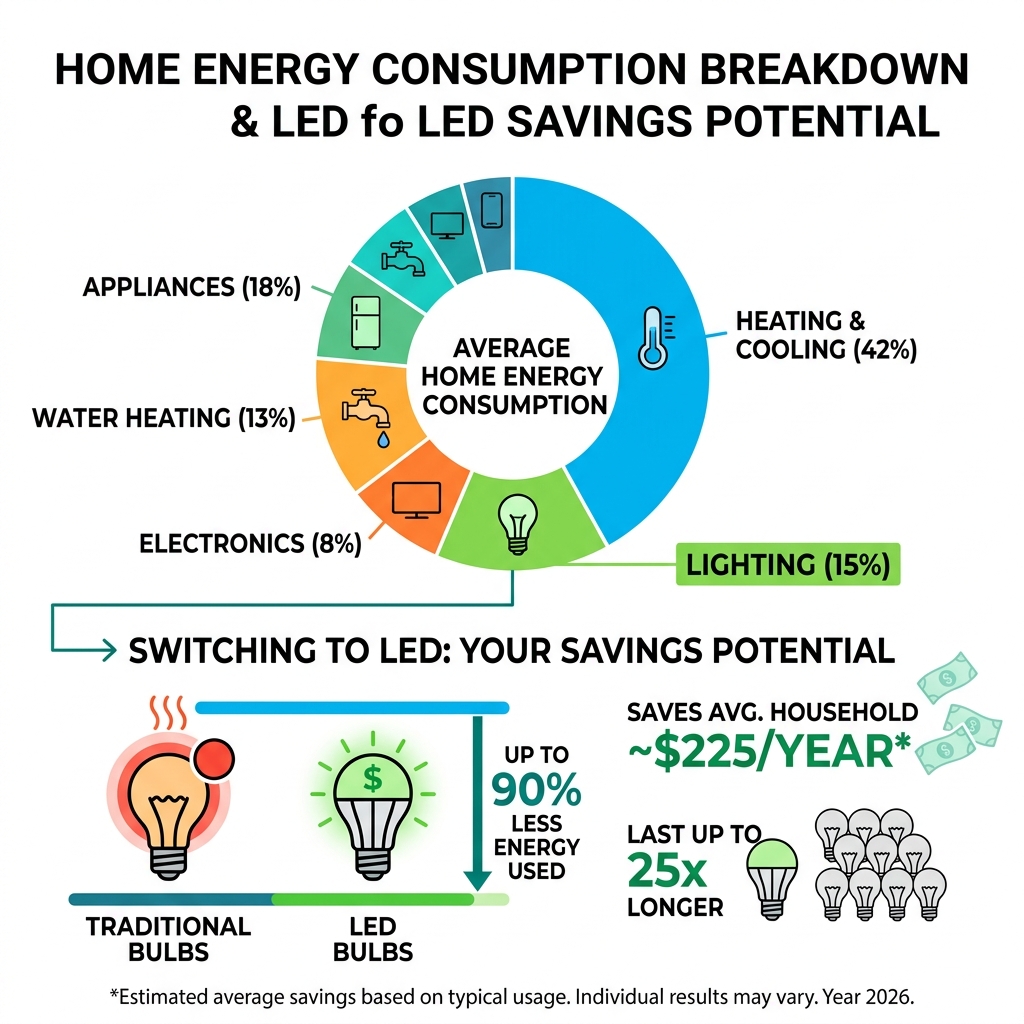
- Lighting eats ~15% of your home’s electricity — that’s a significant chunk of your monthly bill
- Switching to LED bulbs saves the average household around $225 per year
- LEDs use up to 90% less energy than traditional incandescent bulbs
- Incandescent bulbs waste 90% of their energy as heat, not light
- LEDs last up to 25 times longer — meaning fewer replacements and less hassle
It’s a surprisingly big problem hiding in plain sight. Most people don’t think of a light bulb as an energy-hungry appliance. But flip on enough of them, leave them running long enough, and you’re quietly burning through money every single month.
The good news? The fix is simple. Small changes to the bulbs you buy and the habits you keep can add up to real, lasting savings — without turning your home or your life upside down.
This guide walks you through everything, step by step.
Why Switching to LED is the Best Way to Save Energy Lighting
When we talk about making a home more efficient, we often think of solar panels or high-tech insulation. While those are great, the humblest hero in the room is the LED bulb. If you are still using old-school incandescent bulbs, you aren’t just lighting your room; you are essentially running a tiny, expensive space heater. Research shows that a staggering 90% of the energy used by an incandescent bulb is given off as heat rather than visible light.
By contrast, Light Emitting Diodes (LEDs) are solid-state lighting devices that use semiconductors to convert electricity into light with incredible precision. This technology allows them to use at least 75% to 90% less energy than traditional bulbs. But the savings don’t stop at the electric meter.
The Long Game: Lifespan and Payback
One of the most mind-blowing statistics in Save energy lighting is the lifespan of these modern marvels. A quality LED lamp can provide lighting for up to 63,000 hours. To put that in perspective, while an incandescent bulb might last 1,000 hours, an LED can last up to 25 times longer. You could go years—even a decade—without needing a ladder to change a ceiling fixture.
The financial math is equally compelling. While the initial cost of an LED might be higher than a “cheap” traditional bulb, the Lighting Choices to Save You Money | Department of Energy highlights that the average payback period for an LED upgrade is between 6 and 24 months. After that, the bulb is essentially putting money back into your pocket through reduced utility bills.
| Feature | Incandescent | CFL (Compact Fluorescent) | LED (Light Emitting Diode) |
|---|---|---|---|
| Energy Use | 100% (Baseline) | ~25% | ~10-20% |
| Lifespan | 1,000 hours | 8,000 – 12,000 hours | 25,000 – 50,000+ hours |
| Heat Emission | High (90% waste) | Medium | Very Low |
| Durability | Fragile glass/filament | Fragile glass | Highly durable/Solid-state |
Beyond the wallet, there is the planet to consider. Switching to LED is one of the simplest ways to reduce your home’s carbon footprint. Because they require less power, they reduce the demand on power plants, leading to significant CO2 reductions over time. For more on how these choices impact your lifestyle, Learn more about eco-friendly lighting.
Understanding Lumens and Selection for Save Energy Lighting
For decades, we were trained to shop for light bulbs by “watts.” We knew a 60-watt bulb was dimmer than a 100-watt bulb. However, watts are a measure of energy consumption, not brightness. As bulbs became more efficient, wattage became a misleading metric.
Today, we shop by Lumens. Lumens measure the actual amount of light a bulb emits. If you want to replace a standard 60W incandescent, you should look for an LED that provides about 800 lumens. This ensures you get the same brightness while only using about 8 to 12 watts of power.
When selecting your bulbs, keep these expert tips in mind:
- Look for the ENERGY STAR label: This ensures the bulb has been independently certified to deliver on its promises of efficiency and quality.
- Check Color Temperature: Measured in Kelvins (K), this tells you if the light is “Warm White” (yellowish, cozy for living rooms) or “Daylight/Cool White” (bluish, great for reading and tasks).
- Dimmers and Compatibility: Not all LEDs are dimmable. Always check the packaging to ensure the bulb is compatible with your existing dimmer switches to avoid flickering or buzzing.
For a deeper dive into these technical specs, check out the Consumer Guide to Energy-Efficient Lighting Fact Sheet | Department of Energy.
Smart Systems and Strips to Save Energy Lighting
The future of Save energy lighting isn’t just about the bulb; it’s about the system. Smart lighting systems allow us to control our home’s atmosphere via smartphone apps or voice commands. You can set schedules so lights never stay on in an empty house or use “human-centric” lighting that adjusts color temperature throughout the day to support your natural circadian rhythms.
LED strips are another fantastic innovation. They are incredibly energy-efficient and offer a low-heat way to add mood lighting under cabinets, behind TVs, or along hallways. Because they are so versatile, they can transform a “dark and dreary” corner into a “bright and cheery” space without a spike in your energy bill. Discover sustainable home brightening methods that incorporate these modern technologies.
Layering Your Home: Ambient, Task, and Accent Lighting
To truly master Save energy lighting, we need to move away from the “one big light in the middle of the ceiling” approach. This often wastes energy by illuminating parts of the room that don’t need it. Instead, we use “lighting layers.”

1. Ambient Lighting
This is your “base” layer. It provides the general illumination for a room. While necessary, you can save energy by using dimmers on your ambient fixtures, allowing you to lower the light levels when full brightness isn’t required.
2. Task Lighting
This is where efficiency gets practical. Task lighting focuses light exactly where you need it—over kitchen counters, bathroom mirrors, or a desk. By using a small, high-efficiency LED desk lamp or under-cabinet strip, you can often turn off the high-wattage overhead lights entirely while you work or cook.
3. Accent Lighting
Accent lighting is the “jewelry” of home design. It’s used to highlight artwork, architectural features, or even a beautiful plant. Because accent lights are targeted, they use very little energy to create a dramatic, high-end feel. Balancing these three types of light can create an intimate, sophisticated atmosphere that is far more efficient than a single bright overhead source. For more inspiration on layering, visit eco-lighting-brightening-your-home-sustainably-2.
Maximizing Efficiency with Advanced Lighting Controls
If you want to be an energy-saving pro, you have to stop relying on your memory to turn the lights off. Humans are forgetful; sensors are not. Lighting controls can automate your savings by ensuring lights are only on when and where they are needed.
- Dimmers: These are the “low-hanging fruit” of energy control. By reducing the power sent to a bulb, you not only save electricity but also extend the life of the bulb. (Just remember to ensure your LED bulbs are labeled “dimmable”!)
- Occupancy and Vacancy Sensors: These use infrared or ultrasonic technology to detect movement. Occupancy sensors turn lights on when you enter and off when you leave—perfect for bathrooms or laundry rooms. Vacancy sensors require you to turn the light on manually but will turn it off automatically if they stop detecting motion.
- Photosensors: These “sense” light. They are most common in nightlights and outdoor fixtures, preventing the light from turning on during the day.
- Timers: Programmable timers can give your home a “lived-in” look while you’re away without leaving the lights on 24/7.
According to the Lighting Controls | Department of Energy, combining these technologies—like a motion sensor paired with a photosensor for outdoor lights—is the gold standard for efficiency.
Outdoor and Security Lighting Strategies
Outdoor lighting often stays on for long periods, which means the potential for energy waste is high. However, it’s also vital for safety and security.
To Save energy lighting outdoors, we recommend three main strategies:
- LED Flood Lights: LEDs are ideal for the outdoors because they are “solid-state,” meaning they don’t have fragile filaments and can withstand vibrations, rain, and snow. They also perform exceptionally well in cold weather, turning on instantly without the “warm-up” period required by some older bulbs.
- Solar-Powered LEDs: For garden paths and decorative accents, solar-powered lights are a “set it and forget it” solution. They harvest energy during the day and illuminate your yard at night for free. Modern versions even come with smart features and motion sensors.
- Daylight Shut-off and Motion Activation: For security lighting, there is no reason for a bulb to be burning at 2 PM. Look for ENERGY STAR-qualified outdoor fixtures that include integrated photosensors and motion detectors. This ensures the light only activates when it’s dark and someone is actually there.
By making these upgrades, you can Upgrade Your Lighting | ENERGY STAR and ensure your home is safe without bleeding money into the night sky.
Frequently Asked Questions about Energy Efficient Lighting
When is the best time to turn off different types of lights?
The “rule” depends on the bulb type:
- Incandescent and Halogen: Turn them off whenever you leave the room. They are so inefficient that even a few minutes of “off” time saves money.
- CFLs: These are more sensitive. The general rule is if you’re leaving for more than 15 minutes, turn it off. If you’re just popping out for a second, leave it on, as frequent switching can shorten the bulb’s life.
- LEDs: These have no “switching penalty.” Turning them on and off does not affect their lifespan. Therefore, turn them off whenever they aren’t needed! For more details, see When to Turn Off Your Lights | Department of Energy.
How much money can I really save by switching to LEDs?
The average household saves about $225 annually. If you are upgrading a large home or a commercial space, the savings can be even more dramatic, often reaching a 70% reduction in lighting-related energy costs. With a payback period of 6 to 24 months, it is one of the highest-ROI home improvements you can make.
Are LED bulbs compatible with my existing dimmers?
Sometimes. Older dimmers were designed for high-wattage incandescent bulbs. When you put a low-wattage LED on an old dimmer, it might flicker, buzz, or fail to dim completely. Always look for “dimmable” on the LED packaging. If issues persist, you may need to swap your wall switch for an LED-compatible dimmer.
Conclusion
At Refugio do Jardim, we believe that a beautiful home should also be a smart, sustainable one. Transitioning to Save energy lighting isn’t just a way to shave a few dollars off your monthly expenses—it’s a step toward energy independence and a smaller environmental footprint.
The “Bright Side” of LED technology is that you don’t have to sacrifice quality for efficiency. You can have the warm, cozy glow of a traditional home with the cutting-edge performance of the 21st century. Whether you’re layering your indoor lights or installing solar-powered security fixtures, every bulb you switch is a win for your wallet and the world.
Ready to transform your space? Light up your life with eco-friendly solutions and start your journey toward a brighter, greener future today.
