
Why Your City’s Wallet Loves Public Transit
The Personal Payoff: How Transit Saves You Thousands
#
The economic benefits of public transportation are bigger than most people realize — and they affect you whether you ride the bus or not.
Here’s a quick summary of the key economic benefits:
| Benefit | What It Means for You |
|---|---|
| Individual savings | Riders save thousands per year by avoiding fuel, parking, and car ownership costs |
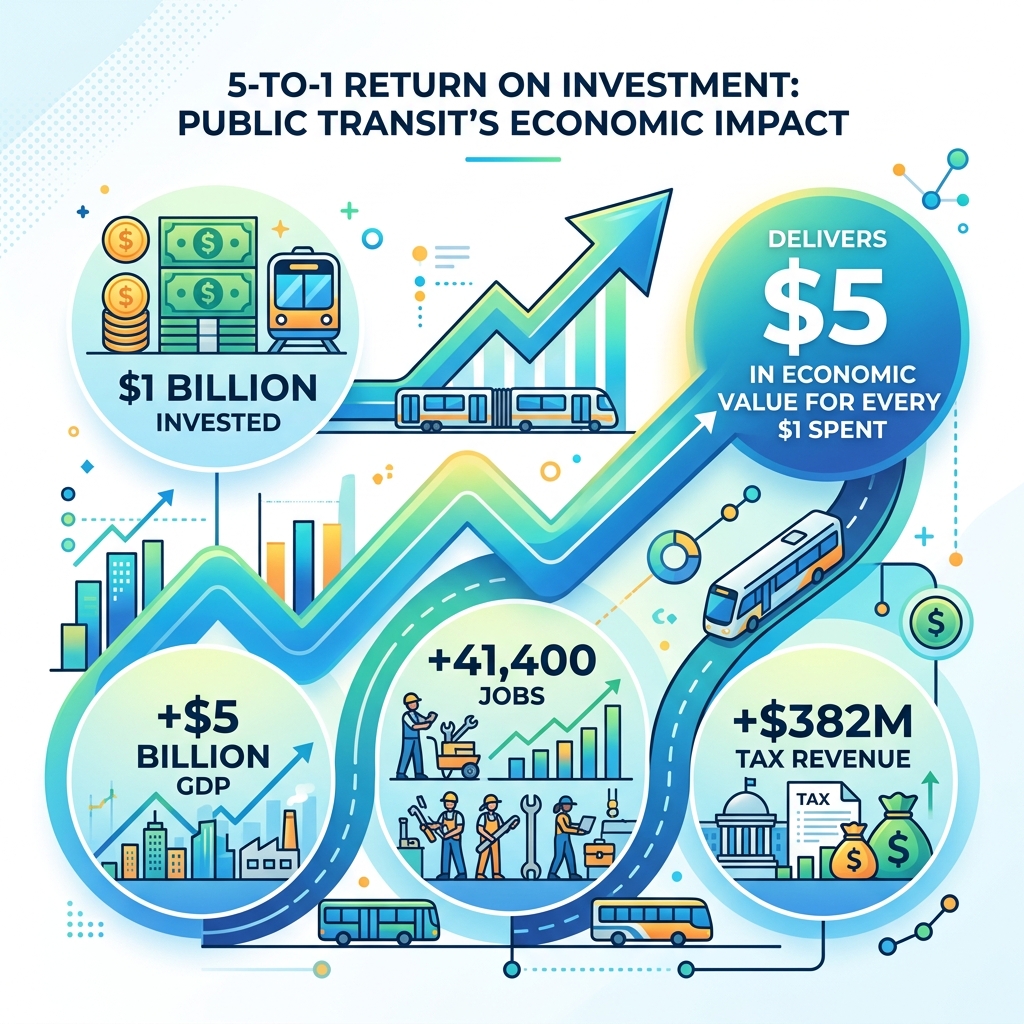
| Job creation | Every $1 billion invested supports around 41,400 jobs |
| Tax revenue | Each $1 billion invested generates $382 million in tax revenue |
| Business growth | Transit corridors attract private investment and new businesses |
| GDP boost | Sustained investment delivers $5 in economic value for every $1 spent |
| Reduced public spending | Transit cuts congestion costs, healthcare costs, and public assistance needs |
Public transit is a $93.4 billion industry in the United States alone. It moves people to work, doctors, schools, and shops — over 7.66 billion trips in 2024. That’s not just mobility. That’s economic activity at a massive scale.
And here’s the thing most people miss: 87% of those trips directly connect people to economic activity — jobs, retail, healthcare, and entertainment. When transit works well, local economies work better too.
Whether you’re a daily commuter or someone who has never stepped on a bus, the health of your city’s transit system shapes your cost of living, your neighborhood’s property values, and the quality of local services around you.

When we talk about the economic benefits of public transportation, we usually start with the big numbers — billions in GDP and thousands of jobs. But for the average person, the most immediate impact is found right in their own bank account.
Owning a car is one of the largest expenses a household can face. Research shows that the fixed costs of car ownership sit at approximately $8,287 per year. When you add in fluctuating fuel prices, routine maintenance, registration, and those dreaded city parking fees, that number climbs even higher. In fact, many American families spend more than 15% of their annual income just on getting around.
By switching to public transit, individuals can slash these costs. You aren’t just saving on gas; you’re reducing the wear and tear that leads to expensive mechanic visits and potentially lowering your insurance premiums. For those living in rail-oriented cities, the savings are even more dramatic — households in these areas save an average of $1,300 or more annually compared to car-dependent regions.
If you’re looking for ways to cut down your footprint while padding your wallet, checking out green-commuting-ideas is a great place to start. As noted by Economic Impact of Public Transportation : BATA, transit is essential in modern urban life because it connects residents to businesses and workplaces without the heavy financial burden of a private vehicle.
Individual Cost Savings and Reinvestment
The “magic” of these savings doesn’t stop at the individual’s wallet. When a commuter saves money on fuel or parking, that money doesn’t just disappear; it gets reinvested into the local economy.
A study in Wisconsin found that public transit use saves riders and taxpayers an estimated $730.2 million annually. Of that, a staggering $597 million represents out-of-pocket savings that riders then spend on groceries, clothing, local services, and entertainment. This “consumer reinvestment” creates a secondary wave of economic growth, supporting retail businesses and creating a more vibrant local marketplace.
The Economic Benefits of Public Transportation: A Job-Creating Engine
One of the most powerful economic benefits of public transportation is its ability to put people to work. The transit industry is a massive employer, directly supporting more than 430,000 people in operations, maintenance, and administration.
However, the “multiplier effect” is where the real growth happens. For every $1 billion we invest in public transportation, approximately 41,400 jobs are created or sustained. These aren’t just bus driver positions; they include:
- Construction workers building new lines and stations.
- Engineers and architects designing sustainable transit hubs.
- Manufacturing staff producing buses, rail cars, and signaling equipment.
- Administrative and tech support managing complex logistics.
According to the Economic Impact of Public Transit – APTA, about 77% of federal transit funds flow directly to private sector businesses. This means government investment supports a massive supply chain of over 3,000 suppliers located in 1,700 communities across all 50 states. It’s a win-win: public infrastructure improves while private manufacturing thrives.
Supporting the Knowledge Economy and Tech Sectors
In the modern “knowledge economy,” businesses want to be where the talent is. Tech sectors and entrepreneurial startups increasingly seek out locations with high-quality transit access. Why? Because a reliable transit system expands the labor pool.
When a city invests in light rail or rapid bus transit, labor market participation in neighborhoods within half a mile of stations has been shown to increase by as much as 39%. By making it easier for people to get to work, transit allows companies to hire from a broader, more diverse group of workers. This connectivity has generated upwards of $174 billion in business sales in tech-heavy cities, proving that transit is the literal backbone of innovation.
Boosting Local Business and Property Values
If you want to see the economic benefits of public transportation in action, look at the storefronts along a new transit line. Public transit creates “foot traffic,” and foot traffic creates customers.
Take Tucson’s Sun Link streetcar as an example. Since its inception, it has spurred more than $3 billion in private sector capital investment and led to the creation of 1,500 new jobs. Before the streetcar, some areas hadn’t seen a tower crane in 25 years; after it launched, a “renaissance” followed, with over 100 new businesses opening in the first three years alone.
Transit also makes a city more attractive to visitors. Cities with direct rail access from their airports to downtown terminals see a significant boost in the hospitality sector. Research shows that hotels in these cities generate 10.9% more revenue per room than those in cities without rail connectivity.
| Feature | Transit-Oriented Development (TOD) | Car-Dependent Zones |
|---|---|---|
| Private Investment | High; attracts developers | Moderate to Low |
| Job Access | 39% higher labor participation | Limited by commute times |
| Property Values | Up to 17% increase | Stable/Lower growth |
| Foot Traffic | High; supports local retail | Low; depends on parking |
This phenomenon is known as “agglomeration.” By bringing people and businesses closer together through efficient transport, we increase the productivity of the entire area.
Maximizing the Economic Benefits of Public Transportation through ROI
The return on investment (ROI) for transit is nothing short of spectacular. While critics often point to the high upfront costs of building subways or light rail, the long-term data tells a different story.
As highlighted in the APTA Surface Transportation Authorization Recommendations Deliver $5 in Economic Benefits for Every $1 Invested, the ratio is roughly 5-to-1. For every dollar we put in, the community gets five dollars back in the form of GDP growth, tax revenue, and cost savings. Specifically, $1 billion in investment can generate $382 million in tax revenue, which helps fund other essential services like schools and public safety.
Long-Term Resilience and Social Equity
A city’s economy is only as strong as its most vulnerable residents. One of the most vital economic benefits of public transportation is its role in fostering social equity and long-term resilience.
Federal investments, such as those through the Infrastructure Investment and Jobs Act (IIJA), are increasingly focused on “Justice40” goals — ensuring that at least 40% of the benefits of federal investments reach disadvantaged communities. This isn’t just about fairness; it’s about economic efficiency.
For instance, transit provides a lifeline for medical care. An enabled medical trip (a trip a person wouldn’t have been able to make without transit) is valued at approximately $480. By providing access to preventive care, transit helps people manage chronic conditions, avoiding the massive public costs of emergency room visits and poorly managed diseases.
However, we must be mindful of how these investments affect neighborhoods. As noted in Public transport investments as generators of economic and social activity, rising property values near transit can lead to gentrification. Smart cities mitigate this by pairing transit projects with affordable housing policies to ensure that the people who need transit most aren’t priced out of the neighborhoods it serves.
How Disinvestment Erases the Economic Benefits of Public Transportation
What happens when we stop investing in transit? The consequences are often more expensive than the investment itself. Disinvestment leads to a “death spiral” of service cuts, declining ridership, and increased social costs.
When rural bus lines close, as seen in parts of North America, residents are often left with no choice but to miss medical appointments or forgo employment. This leads to increased social isolation and a higher reliance on public assistance. Furthermore, ignoring the $123 billion “state of good repair” backlog in our current systems leads to vehicle failures and delays that cost the economy millions in lost productivity.
According to Long-Term Economic Benefits and Impacts from Federal …, failing to maintain and expand our transit infrastructure results in increased congestion costs and a decline in regional competitiveness.
Frequently Asked Questions about Transit Economics
How does public transit impact local property values?
Public transit typically boosts property values. Proximity to a station is a major selling point for both residential and commercial real estate. In some regions, property prices have risen by as much as 17% following the introduction of high-speed or light rail. This is because people value the convenience of a shorter, cheaper commute.
What is the typical return on investment for transit projects?
The industry standard ROI is 5-to-1. This means that for every $1 billion invested, the community sees $5 billion in long-term economic benefits. This includes direct spending impacts, job creation, and long-term productivity gains from reduced congestion and better access to jobs.
How does public transportation reduce government spending?
While transit requires subsidies, it saves the government money in other areas. It reduces the need for expensive roadway expansions, lowers public assistance spending by helping people reach jobs, and decreases healthcare costs by providing access to medical appointments. In Wisconsin alone, transit saves taxpayers over $74 million in public assistance costs annually.
Conclusion
At Refugio do Jardim, we believe that sustainable urbanism is the key to a flourishing future. The economic benefits of public transportation prove that when we choose to invest in our communities, the rewards are shared by everyone. From the thousands of dollars saved by individual households to the billions generated in GDP and tax revenue, transit is the engine that keeps our cities moving forward.
By supporting public transportation, we aren’t just building tracks and buying buses — we are investing in community competitiveness, economic mobility, and a more resilient world.
Ready to make a change in your daily routine? Start your journey toward sustainable commuting today and see how much your wallet (and your city) can benefit.
